Launching an ecommerce store in another market involves more than translating product titles and descriptions. A product page may also contain size charts, comparison graphics, promotional banners, feature callouts, packaging instructions, and downloadable PDF manuals—all of which can carry text that customers need to understand.
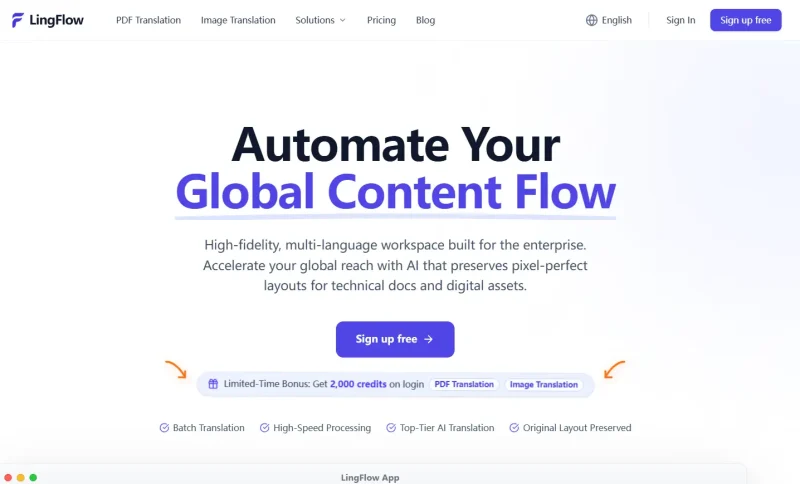
For brands managing dozens or hundreds of visual assets, manually recreating every image in another language quickly becomes a production problem. An ecommerce localization tool such as LingFlow is designed for this part of the workflow, helping cross-border ecommerce teams translate product images, marketing posters, and PDF materials through an AI-assisted visual localization process.
LingFlow is built around a workflow of uploading the original asset, translating its content with AI, and reviewing or editing the localized visual online. It is aimed specifically at cross-border sellers, international marketers, localization teams, technical-document professionals, and digital content creators.
Ecommerce Localization Often Stops Too Early
Most international storefront projects begin with text.
Teams translate:
- product titles;
- descriptions;
- navigation;
- FAQs;
- shipping information;
- return policies.
That work is important, but ecommerce pages are increasingly visual.
Customers Read the Images Too
A product image may contain:
- dimensions;
- material information;
- usage instructions;
- feature comparisons;
- promotional claims;
- product variants;
- step-by-step guidance.
If the product description is localized but these graphics remain in the original language, the customer experience becomes inconsistent.
Ecommerce Fastlane has recently highlighted a similar problem with translation consistency across storefronts, support, email, and other customer touchpoints: individually understandable translations can still create friction when language changes from one channel to another.
Visual assets create another layer of that same problem.
Product Images Are Part of the Localization Workflow
For many ecommerce brands, visual content is produced before international expansion begins.
The original creative team may have designed every product image for one market.
When the brand enters another country, the localization team inherits finished assets rather than editable source files.
A Single Product Can Generate Many Visual Assets
One listing might include:
- hero image;
- feature infographic;
- comparison chart;
- dimensions graphic;
- usage image;
- promotional banner.
Multiply that by 50 or 100 SKUs and the amount of localization work grows quickly.
LingFlow is specifically designed to handle multilingual visual materials, including product images and marketing posters. Its product documentation also highlights batch scenarios such as processing around 100 product images for cross-border listing work.
Why Copying Text Into a Translator Is Not Enough
The translation itself is only one part of visual localization.
A designer could theoretically:
- open the image;
- identify every text element;
- copy the wording;
- translate it;
- return to the design file;
- replace the original text;
- resize text boxes;
- check the new layout;
- export the asset.
Doing that once may be manageable.
Doing it across an ecommerce catalogue becomes expensive in time.
Different Languages Occupy Different Amounts of Space
A short English feature label may become significantly longer when translated.
That can affect:
- line breaks;
- text boxes;
- spacing;
- alignment;
- hierarchy.
Visual localization therefore requires a review step after translation.
LingFlow combines AI translation with online visual editing and checking, so teams can review the localized asset instead of treating machine translation as the final production file.
A More Practical Workflow for Product Image Localization

For an ecommerce team expanding into another market, visual localization can be treated as a repeatable production process.
Step 1: Start With Approved Source Assets
Use the current product images rather than an old creative folder.
Before translation begins, confirm:
- product version;
- pricing claims;
- dimensions;
- feature names;
- promotional wording.
This matters because localization should not preserve outdated product information.
Step 2: Translate the Visual Content
The product image or marketing visual can then enter LingFlow’s AI translation workflow.
The goal is to create a localized version without manually rebuilding every graphic from the beginning.
Step 3: Review the Translation in Context
A translation can be linguistically correct but still look wrong inside the image.
Review:
- terminology;
- line wrapping;
- spacing;
- text hierarchy;
- product names;
- units;
- numbers.
Step 4: Compare Against the Original Product Information
Product facts should stay consistent.
Ecommerce Fastlane’s coverage of AI product-image workflows makes a similar point: AI-assisted creative production still requires comparison against approved source assets so the final material does not misrepresent the product.
That principle applies to localized graphics as well.
Terminology Consistency Matters Across Product Images
Imagine an electronics brand selling a product with a specific accessory name.
The product page uses one translation.
The size chart uses another.
The instructional graphic uses a third.
The customer may understand all three individually and still wonder whether they refer to the same item.
Build a Small Terminology List Before Scaling
For each market, identify terms that should remain consistent:
- product names;
- variant names;
- materials;
- features;
- accessories;
- measurement units;
- warranty terms.
Ecommerce Fastlane recently described this wider issue as “translation drift,” where terminology gradually changes across different parts of the customer journey.
The same control should extend to visual content.
Marketing Posters Need More Than Literal Translation
Promotional content introduces another problem.
Marketing copy is often short, emotional, and dependent on context.
A literal translation of a campaign headline may be grammatically correct while sounding unnatural in the target market.
Separate Product Facts From Marketing Language
Product facts should remain stable:
Battery life: 12 hours
Capacity: 500ml
Material: Stainless steel
Marketing language deserves more editorial judgment:
Built for Every Adventure
A localization team may decide that the target language needs a different expression to communicate the same campaign idea naturally.
LingFlow can accelerate the visual translation workflow, while marketers remain responsible for deciding whether the final language fits the market and brand.
PDF Manuals Are Another Ecommerce Localization Bottleneck
International ecommerce does not stop at the product page.
Customers may also receive:
- user manuals;
- installation guides;
- care instructions;
- product documentation;
- downloadable PDFs.
These documents can contain a mixture of text, images, tables, and designed layouts.
LingFlow’s confirmed use cases include PDF manuals as well as product images and marketing posters.
Layout Matters in Instructions
A manual may place a warning beside a diagram or connect a step with a specific product image.
Translating the wording separately can disconnect those relationships.
A layout-aware localization workflow can reduce the need to reconstruct the entire manual after the translation stage.
Batch Localization Matters When the Catalogue Grows
The economics change once a brand has many SKUs.
Localizing five images manually may be reasonable.
Localizing hundreds of product graphics across several markets becomes a content-operations challenge.
Think in Asset Sets
Instead of asking:
“How do we translate this image?”
the better operational question is:
“How do we localize this product’s complete visual asset set?”
For example:
Product A
- Hero image
- Dimensions graphic
- Benefits graphic
- Comparison chart
- Instruction card
- PDF manual
The same structure can then be repeated for Product B, Product C, and the rest of the catalogue.
LingFlow’s positioning around batch visual-material localization makes it particularly relevant at this stage.
Human Review Still Belongs Before Publishing
AI can reduce repetitive translation and layout work, but ecommerce content directly affects purchasing decisions.
That means localized assets should be reviewed before they reach the storefront.
Review Product Accuracy
Check:
- specifications;
- quantities;
- measurements;
- model numbers;
- feature claims.
Review Language
Check whether the wording sounds natural to the intended audience.
Review Visual Layout
Check whether translated text fits comfortably inside the original design.
Review Brand Consistency
Make sure terminology matches the rest of the localized storefront.
This is especially important when several people or tools are producing content for the same international launch.
Build Localization Into the Content Production Process
For ecommerce teams planning regular international expansion, localization works better when it becomes part of asset production instead of an emergency task before launch.
A scalable workflow might look like:
Approved source assets → AI-assisted localization → Online visual review → Terminology and product-fact check → Market approval → Publish
LingFlow fits into the middle of this process by combining translation with visual-material editing and review.
For ecommerce brands, that changes localization from a series of isolated design requests into a repeatable content-production workflow.
FAQ
What types of ecommerce content can LingFlow localize?
LingFlow is designed for visual multilingual materials including product images, marketing posters, and PDF manuals.
Who is LingFlow designed for?
Its target users include cross-border ecommerce sellers, international operations teams, marketing managers, technical-document professionals, localization agencies, and digital content creators.
Can LingFlow be used for multiple product images?
Yes. The product positioning specifically includes batch ecommerce scenarios involving large groups of product images.
Does AI translation remove the need for review?
No. Product terminology, specifications, marketing language, and visual layout should be checked before localized assets are published.
Why localize text inside product images?
Customers often rely on visual assets for dimensions, features, comparisons, and instructions. Leaving image text untranslated can create an incomplete customer experience even when the storefront description has already been localized.