If there’s one skill that separates a confident home cook from a frustrated one, it’s knife work. Not fancy knife tricks or chef-school techniques — just the basics done right. Knowing how to properly slice a steak, break down a chicken, or fillet a piece of fish changes everything about how you cook. Your meals look better. They taste better. And prep time drops dramatically.
The good news is you don’t need years of experience to get there. You need the right information, a little practice, and a sharp blade. Let’s break it all down.
Why Your Knife Matters More Than You Think
Before we get into technique, let’s talk about the tool itself — because no amount of skill compensates for a dull or wrong knife.
Most home cooks are working with a single all-purpose knife they’ve had for years, used it for everything, and barely sharpened once. That knife is doing a lot of work — but it’s probably not doing any of it as well as it could.
Different cuts call for different blades. A boning knife for working around joints. A fillet knife for fish. A long carving knife for slicing roasts. And for everyday prep — slicing, dicing, breaking down proteins — you want a quality chef’s knife that holds its edge through extended sessions.
If you’re thinking about upgrading, a Damascus knife is worth serious consideration. The layered steel construction — two or more steel alloys forge-welded together — gives these blades exceptional edge retention and a sharpness that lasts noticeably longer than standard stainless steel. For home cooks doing regular meal prep, that means fewer sharpening sessions and more consistent results every time you pick it up. You can find quality options at DSKKBlade Damascus knife without spending professional chef money.
Now, on to the techniques.
How to Slice Steak the Right Way
This is probably the single highest-impact skill in this entire guide. You can cook a perfect steak and completely ruin it in the last ten seconds if you slice it wrong.
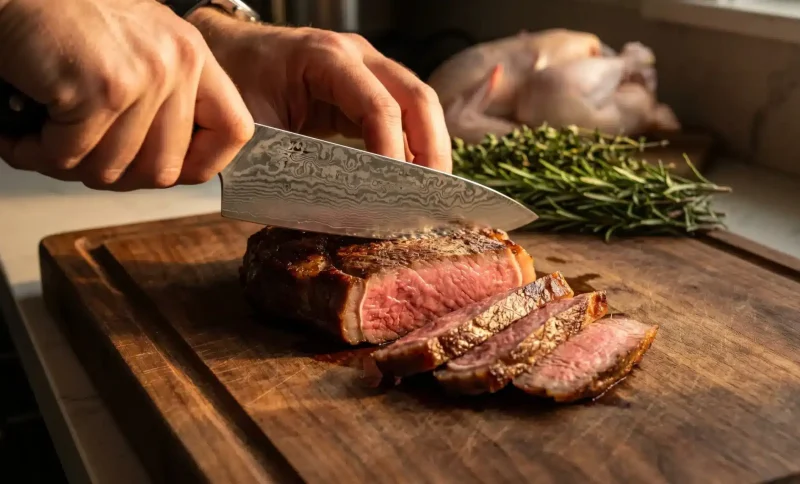
The mistake almost everyone makes: cutting with the grain instead of against it. Every cut of beef has muscle fibers that run in one direction. If you slice parallel to those fibers, you’re pulling long, tough strands apart with every chew. If you slice perpendicular — across those fibers — you’re shortening them, which makes the exact same piece of meat dramatically more tender.
Here’s how to do it:
First, rest your steak. At least five minutes for smaller cuts, up to ten for thicker steaks like ribeye or T-bone. This step is non-negotiable — it lets the juices redistribute through the meat rather than running straight onto your cutting board.
While the steak rests, look at the surface and identify the grain. You’ll see thin parallel lines running in one direction. Once you can see them clearly, rotate your board so the lines run left to right, then slice across them — ideally at a slight angle, about 45 degrees.
Use long, confident strokes. Don’t saw back and forth. One smooth pull of a sharp blade gives you a cleaner cut than five short strokes ever will.
Breaking Down a Whole Chicken
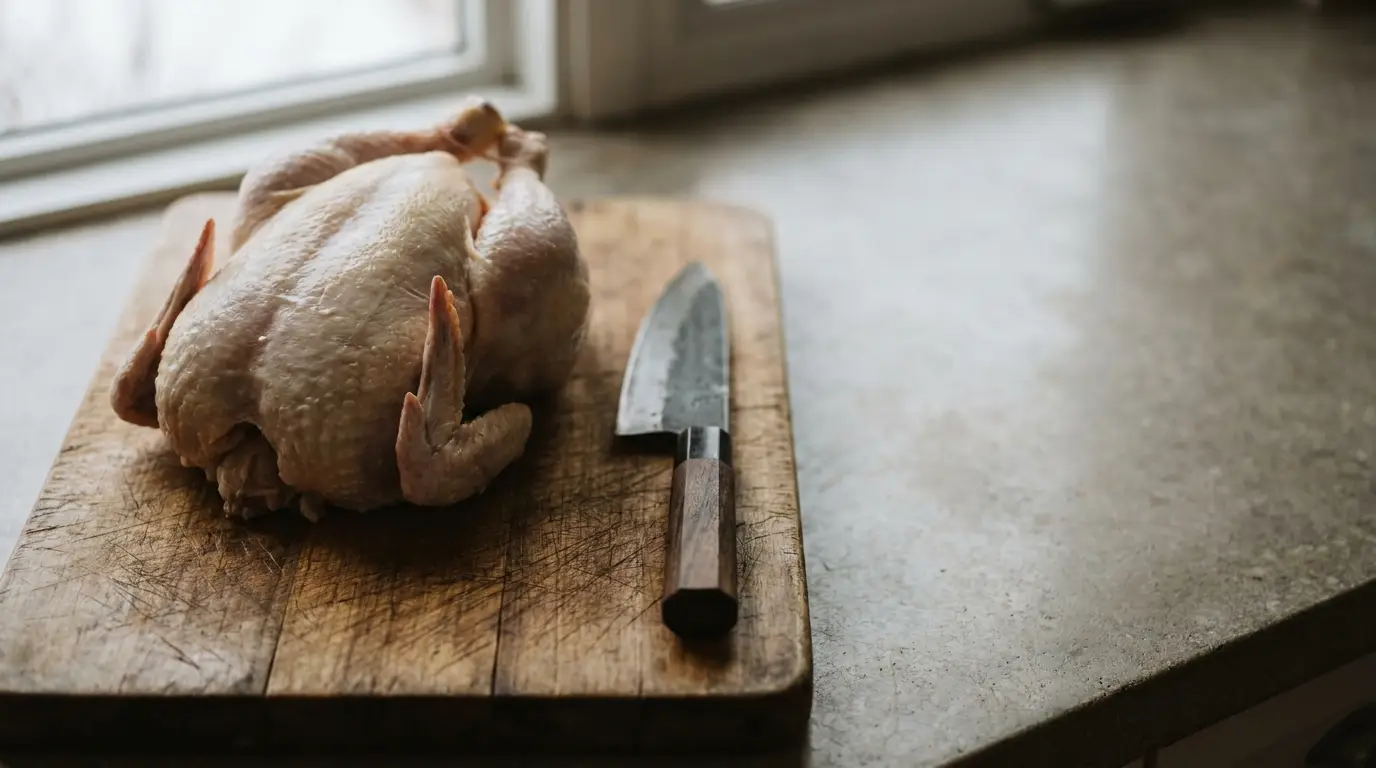
Buying whole chickens is significantly cheaper than buying individual cuts, and once you know how to break one down, the process takes about ten minutes. It’s a genuinely useful skill that pays for itself every time you do it.
You’ll need a sturdy chef’s knife and a stable cutting board. A non-slip mat underneath makes the whole process safer.
Start with the legs. Pull one thigh away from the body with your hand — you’ll feel the joint. Cut through the skin at the crease, then find the joint itself and cut cleanly through it. Don’t force it; if you’re positioned right, very little pressure is needed. Repeat on the other side. Then separate the thigh from the drumstick by finding the fat line that runs across the joint and cutting straight through it.
For the breasts, stand the bird up vertically and run your knife alongside the breastbone, following the ribcage down as closely as possible. The goal is to recover as much meat as you can, so take your time here. Once the breast is free, you can leave it whole or slice it crosswise into portions.
Save the backbone and carcass. Throw them in a freezer bag and use them later for stock — it’s basically free flavor.
Filleting Fish at Home
Fresh fillets you break down yourself taste noticeably better than pre-cut supermarket fish. There’s less handling, no sitting time, and you control the cut.
The key tool here is a flexible fillet knife. A rigid chef’s knife works in a pinch, but it’s much harder to navigate around the spine and pin bones without tearing the fillet.
Lay the fish flat. Make an initial cut just behind the gills, angling your blade toward the head and cutting down until you feel the spine — but don’t cut through it. Turn the blade flat, then run it along the top of the backbone from head to tail using smooth, sweeping strokes. Let the knife do the work; applying too much pressure causes you to drag through the flesh instead of gliding over the bone.
Once the fillet is free, run your finger along the center line to feel for pin bones. Use a pair of kitchen tweezers or needle-nose pliers to remove them — they pull out cleanly when the fish is fresh.
For firm fish like salmon, steelhead, or sea bass, this whole process is forgiving and fairly quick. For thinner, more delicate fish, slow down and use lighter strokes.
Keeping Your Knives Sharp
Even the best knife needs maintenance. The two tools worth owning are a honing rod and a whetstone.
A honing rod doesn’t actually sharpen a blade — it realigns the edge between uses. Run your knife along it at a consistent 15–20 degree angle before each cooking session and your knife will perform noticeably better over time.
A whetstone is what you use when the knife actually needs sharpening — when honing alone doesn’t restore the edge. Start with a coarser grit to reshape the edge, then move to a finer grit to refine and polish it.
Storage matters too. Tossing knives loose in a drawer damages the edge every time they knock against other utensils. A magnetic wall strip or a knife block keeps edges protected and the blade ready to use.
Hand wash your knives and dry them immediately. Dishwashers are harsh on both the edge and the handle — the heat, detergent, and movement all accelerate wear.
Putting It All Together
Better knife skills aren’t just about efficiency — they change the quality of what ends up on the plate. Even cuts cook evenly. Properly sliced steak is more tender. Clean fillets hold their shape in the pan. These are real, noticeable improvements that come directly from technique.
Start with one skill at a time. Practice slicing a steak against the grain this week. Break down your first whole chicken next. Each time it gets faster and more natural. And once you have the right blade in your hand — sharp, well-balanced, built to hold an edge — you’ll understand exactly why professional cooks are so particular about their knives.
It makes every single thing easier.