Few people think about optimizing their furnace performance when conditions are fair. It’s a box in the basement that sits there and does its job fairly. That means the heating system gets ignored, right up until it stops working on a -20°C Calgary night. Then suddenly it becomes a survival lifeline.
A mind shift is critical. Don’t wait for such moments. Pay attention to that strange sound, uneven heating or a sudden cold room. In Calgary, responding to those early signals is often a much better strategy than waiting for the system to make the decision for you.
Give the Furnace a Head Start Before Calgary Gets Cold
September and October are good months to have the furnace looked over. There is still time to deal with a worn component or developing problem before the heating system is suddenly working much harder every day.
And a proper tune-up should be more than turning up the thermostat and saying, “It works.” An experienced Calgary Furnace Repair Company will undertake a comprehensive mechanical and safety inspection, not just a basic operational test. That may include:
- Heat Exchangers and Burners: Cracks mean carbon monoxide. Full stop. They need an explicit inspection for physical degradation.
- Safety Limits and Flame Sensors: These are the internal kill-switches. If they fail, the system either dies randomly or doesn’t shut off when it should.
- Blower Assembly: Dust buildup on motor blades degrades airflow exponentially.
- Thermostat Signals: Verifying the actual brain is communicating cleanly with the board.
Catching a failing component in October gives complete control over the repair. Waiting until December means paying emergency rates while freezing.
For an older furnace, this kind of inspection can be especially useful. You may discover that a relatively small repair is all that is needed—or that the equipment is beginning to show signs that replacement should eventually be considered. Either way, you are making the decision while you have choices, rather than in the middle of an emergency.
Do Not Underestimate the Furnace Filter
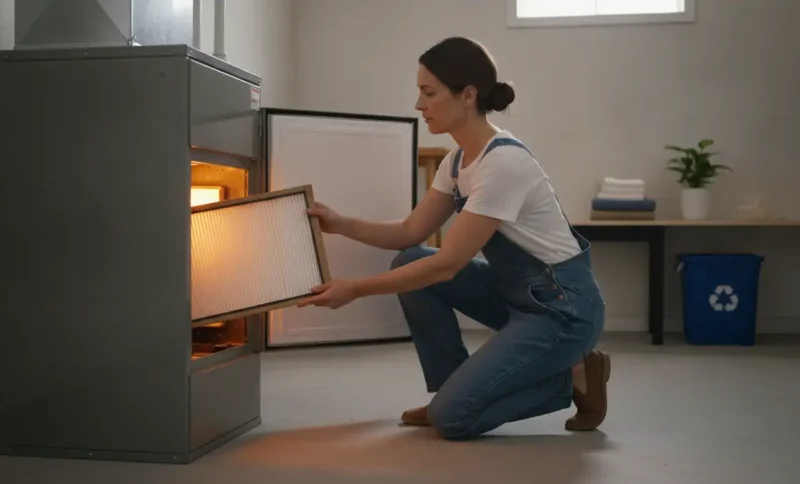
While your furnace can be several feet tall and weighing over 100 pounds, the furnace filter which is only about 1-5 inches thick plays a critical role that can pull down the functionality of your machine with ease.
The filter is at a critical point that supplies the heating system with air, clean air. That means when this critical gateway starts restricting airflow, the machine overheats, and the system senses danger; it shuts down.
But how often should you replace it? That depends on the home. A household with pets, renovation activity or heavier dust levels may need to check its filter much more often than a relatively clean, low-occupancy home.
A few things are worth getting right:
- Use the appropriate filter: Follow the furnace manufacturer’s recommendations rather than assuming the highest MERV rating is automatically best.
- Look at your household conditions: Pets and higher levels of dust can mean more frequent replacement.
- Check the arrow: The airflow direction printed on the filter needs to match the direction air moves through your system.
A good service provider will optimize your furnace filter capabilities enhancing balanced airflow efficiency, filtration quality, and replacement timing based on specific household conditions.
Give Carbon Monoxide Protection the Attention It Deserves
Fuel burning furnaces produce carbon monoxide, which is normally trapped by heat exchangers and safely released outdoors. But in case of leaks due to a malfunction, CO is dangerous. Even worse, the gas is hard to naturally detect because it does not smell.
As such, installing detection and alarm systems along with your furnace is a critical safety protocol. Experts follow critical instructions and applicable local requirements when deciding where alarms should be installed. Appropriate detection near sleeping areas and on different levels of the home can provide an important layer of protection.
Professional maintenance helps keep the alarms in working order.
- Performing tests according to the manufacturer’s instructions.
- Replacing batteries as recommended for your particular model.
- Checking the replacement date on the alarm.
Note: Never ignore an alarm or assume it is simply malfunctioning without taking the appropriate safety steps.
However, an alarm is not a substitute for professional furnace inspection. The two serve different purposes. One alerts you to a potential danger; the other helps assess the equipment that could contribute to that danger.
Keep the Air Moving, Inside and Outside the Home
Deciding when to do duct cleaning deserves a little common sense too. It is not something you have to restrict on a fixed schedule. If you are seeing unusually heavy dust, noticing persistent odors or experiencing a specific airflow concern, have the situation professionally assessed first.
That distinction saves homeowners from paying for work simply because someone said it was “due.” A furnace cannot perform properly if the air it depends on cannot move freely. Inside the house, check that furniture, rugs and other belongings are not covering supply registers or return-air grilles. A room that suddenly feels colder may have more to do with restricted air distribution than with a failing furnace.
In essence, good furnace care is really about having a professional holding your hand and making better decisions at the right time. Know what your system normally sounds and feels like, pay attention when that changes, and bring in qualified expertise when the issue goes beyond routine homeowner care. In Calgary, that mindset does more than protect comfort; it gives you greater control over the performance, safety and long-term value of your heating system.