If sleep has become harder, a useful starting point is to finish a normal coffee about eight hours before bedtime. Someone who usually sleeps at 11 p.m., for example, could try making 2 to 3 p.m. the last caffeinated coffee of the day.
That is a starting point, not a universal cutoff. A small coffee, a large cold brew and a 300 mg pre-workout can affect sleep very differently. Some people also clear caffeine faster than others.
Research supports a simple rule: the later the caffeine and the larger the dose, the more likely it is to interfere with sleep. The best cutoff is therefore based on your bedtime, your usual dose and what happens to your sleep when you move that dose earlier.
How Many Hours Before Bed Should You Stop Caffeine?
A 2023 systematic review and meta-analysis of 24 studies found that caffeine reduced total sleep time by about 45 minutes on average. It also increased the time needed to fall asleep, increased wakefulness during the night and reduced deep sleep. Based on the studies included, the researchers estimated that a coffee containing about 107 mg of caffeine would need to be consumed approximately 8.8 hours before bedtime to avoid reducing total sleep time.
For a typical bedtime, that gives a practical starting range:
|
Usual bedtime |
Starting cutoff for a roughly 100 mg coffee |
| 10 p.m. | Around 1 p.m. |
| 11 p.m. | Around 2 p.m. |
| Midnight | Around 3 p.m. |
These times should not be treated as medical rules. They are a reasonable experiment for someone who already suspects that afternoon caffeine is affecting sleep.
Dose can move the cutoff substantially.
A 2025 randomized crossover trial compared 100 mg and 400 mg doses taken 12, 8 or 4 hours before bedtime. In the 23 men studied, the 100 mg dose did not significantly change objective or subjective sleep outcomes even when taken four hours before bed. The 400 mg dose was different. It delayed sleep and altered sleep architecture when consumed within 12 hours of bedtime, with more sleep fragmentation when taken within eight hours.
The two studies are not contradictory. They show why a single rule such as “no coffee after 2 p.m.” is incomplete.
A modest dose may be tolerated later by some people. A high dose can affect sleep much earlier in the day.
If you drink a large cold brew or use a caffeinated pre-workout, check the milligrams rather than assuming it is equivalent to one ordinary cup of coffee.
Find Your Cutoff From the Dose You Actually Drink

“One coffee” is not a useful measurement of caffeine.
The FDA lists regular 12-ounce brewed coffee at roughly 113 to 247 mg of caffeine, while energy drinks can also vary widely. Tea, chocolate, supplements and some medications contribute additional caffeine, and even decaf coffee usually contains a small amount.
That variation explains why two people can both stop drinking coffee at 3 p.m. and have completely different results.
Start by looking at the final meaningful dose of your day. If it is a small coffee and you sleep well, there may be no reason to change it. If it is a large café drink, an energy drink or pre-workout, moving it earlier is more useful than focusing on the word “afternoon.”
The FDA cites 400 mg per day as an amount not generally associated with negative effects for most healthy adults, but that figure refers to total daily intake, not to the amount likely to preserve sleep when consumed late in the day. The FDA also notes wide individual variation in both caffeine sensitivity and how quickly people eliminate caffeine.
This makes personal response important. If you can drink coffee after dinner and consistently sleep well, your practical cutoff may be later than someone who notices lighter sleep after a 2 p.m. latte. If sleep is already unreliable, however, moving caffeine earlier is an easy variable to test before adding more complicated changes.
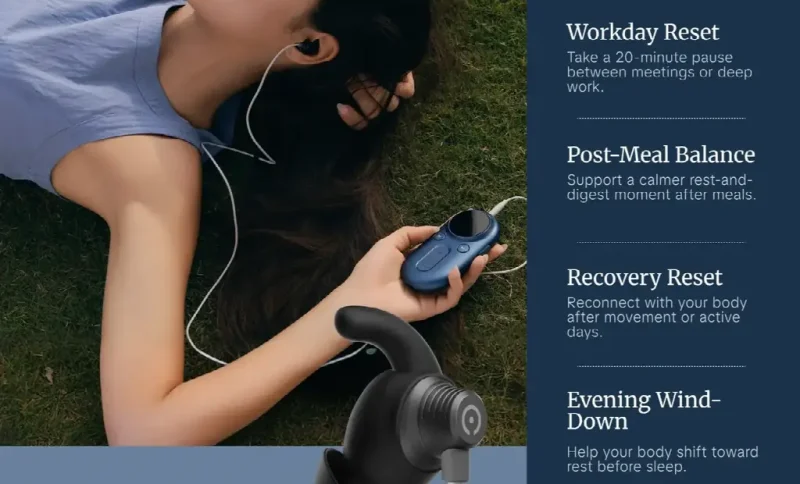
If your caffeine intake is already early and the remaining problem is difficulty settling at night, relaxation practices address a different part of the routine. Some people also explore non-drug options such as a vagus nerve stimulator for sleep. That type of tool should not be used as a way to compensate for caffeine taken too close to bedtime. Fix the stimulant timing first.
Your desired sleep time also matters more than the hour shown on the clock. Travel is a good example. Coffee that helps you stay alert through an airport wait can work against you if you plan to sleep several hours later on the flight. If that is the problem you are trying to solve, this guide on how to rest on a plane when you’re not tired covers the wider challenge of sleeping when your usual schedule and the travel schedule do not line up.
The same principle applies at home. Count backward from when you want to sleep, not from an arbitrary rule about when afternoon coffee becomes “too late.”
Test One Caffeine Change for a Week
If you are unsure whether caffeine is affecting your sleep, changing everything at once makes the answer harder to find.
Keep your morning coffee if you enjoy it. Keep bedtime reasonably similar. Change only the final caffeine dose.
For example, if you usually drink coffee at 4 p.m. and sleep at 11 p.m., move that drink to 2 p.m. for a week. Pay attention to whether you fall asleep more easily, wake less often or feel more rested the following morning.
If there is no clear difference, move the cutoff another hour earlier.
You do not need to judge the experiment from one night. Sleep naturally varies, so several days provide a better comparison.
Also avoid judging caffeine only by whether you managed to fall asleep. Caffeine can change sleep even when someone does not feel obviously “wired.” The 2023 meta-analysis found effects on total sleep time, sleep efficiency, nighttime waking and deep sleep. The 2025 trial also found that people did not always accurately perceive the objective effects of the higher caffeine dose on their sleep.
Morning dependence can offer another clue. If poor sleep leads to more caffeine the following day, and that extra caffeine extends later into the afternoon, the pattern can reinforce itself:
poor sleep → more caffeine → later caffeine → poorer sleep
Moving the last dose earlier can interrupt that cycle without requiring you to give up coffee altogether.
If you want to reduce your total caffeine intake as well, do it gradually. The FDA notes that suddenly stopping habitual caffeine can cause unpleasant withdrawal symptoms.
If Earlier Caffeine Does Not Improve Your Sleep
Caffeine is worth checking because the timing is relatively easy to change. It should not become the explanation for every bad night.
If your last meaningful caffeine dose is already eight or more hours before bedtime, you move it earlier for a week or two, and nothing changes, another factor may be more important.
Stress can keep the mind active at night. An irregular schedule can make sleepiness arrive at the wrong time. Alcohol can fragment sleep. Pain, medications and other health conditions can also affect sleep.
Persistent trouble falling asleep, repeated nighttime waking or early waking may need a broader look, particularly if the problem continues despite enough opportunity to sleep.
Symptoms such as loud habitual snoring, breathing pauses, gasping during sleep, marked daytime sleepiness or uncomfortable leg sensations at night also should not be explained away as a caffeine problem.
For ordinary coffee-related sleep disruption, however, the decision can stay simple.
Start with about an eight-hour buffer for a typical coffee if sleep is already a concern. Move the cutoff earlier when the dose is higher. Count caffeine from all sources rather than counting cups, and test the change against your own sleep for several days.
There is no perfect afternoon hour that works for everyone. The useful cutoff is the latest time you can have your usual amount of caffeine without making your usual bedtime and sleep worse.
References
- Gardiner C, Weakley J, Burke LM, et al. The effect of caffeine on subsequent sleep: A systematic review and meta-analysis. Sleep Medicine Reviews. 2023.
- Gardiner CL, Weakley J, Burke LM, et al. Dose and timing effects of caffeine on subsequent sleep: a randomized clinical crossover trial. Sleep. 2025.
- U.S. Food and Drug Administration. Spilling the Beans: How Much Caffeine is Too Much?