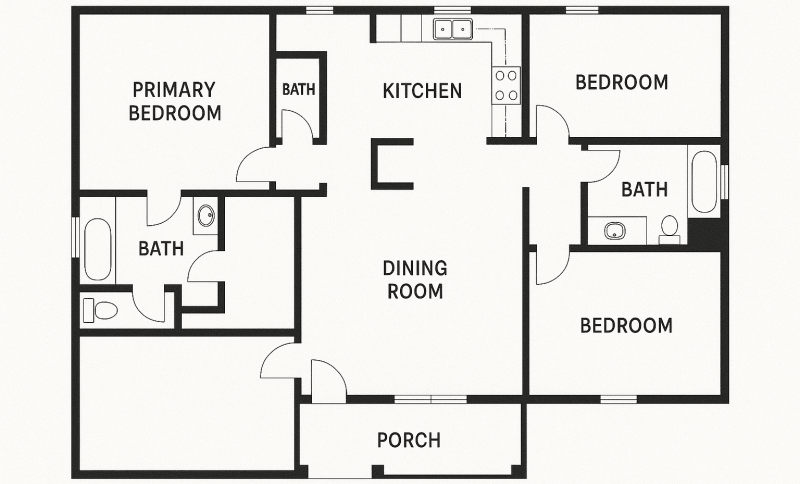
You can buy the most beautiful sofa, invest in designer lighting, and choose the perfect paint color, yet still feel like something is “off” in your home. Nine times out of ten, the problem is not the décor itself. It is the floor plan. If the layout is poorly planned, no amount of styling will fully fix it.
Accurate floor plans are the quiet backbone of every well-designed home. They determine how you move, how you live, how light falls into a room, and how every piece of furniture and décor either complements or clashes with the space. Before you think in cushions and curtains, you need to think in walls, windows, and measurements.
Below, we will walk through how precise floor plans support better décor decisions, more comfortable living, and stronger property value.
Why the Plan Comes Before the Palette
Great décor is not just about taste. It is about context. The same beautiful armchair that looks perfect in a spacious living room can feel bulky and awkward in a narrow terrace house. The difference is the underlying layout.
A floor plan shows the relationship between rooms, doors, windows, and circulation routes. When that information is accurate, you can see how spaces relate to one another: where the natural “hub” of the home is, how people will move from the front door to the main living area, and which walls are natural focal points.
For example, imagine a living room where the only solid wall is directly opposite a doorway. That wall becomes the ideal location for a TV unit or artwork. If you miss that and place your main sofa with its back to the entrance, you are fighting the natural flow of the room. The space will always feel just a bit wrong.
Accurate floor plans help you:
- Identify natural focal points for feature walls, media units, or statement art
- Decide which rooms should feel open and connected, and which should feel more private
- Align décor choices with how people actually use the space, not how you wish it worked
When you plan décor from a precise layout, you create harmony between design and function, instead of decorating “around” a problem that could have been solved on paper.
How Accurate Floor Plans Transform Space Planning and Furniture Placement
Space planning is where floor plans really prove their value. It is not just about whether something fits. It is about whether it fits comfortably and leaves room for real life.
A proper floor plan lets you map out:
- Sofa lengths versus wall lengths
- Dining table sizes versus room dimensions
- Bed sizes versus clearance around them
- Storage needs versus available wall space
Take a typical open-plan living and dining area. Without exact measurements, you might buy a generous sectional and a large dining table because the room “looks big.” Once they arrive, you realize there is barely enough clearance to pull chairs back or walk behind the sofa. Suddenly, the room feels cramped instead of luxurious.
With an accurate plan, you can test different layouts before you buy a single piece:
- Try a two-seater plus armchairs instead of a sectional
- Rotate the dining table to run parallel, not perpendicular, to the kitchen island
- Choose a slimline sideboard that still offers storage but does not eat into the circulation space
You can also plan “zones” within an open area: a reading corner by a window, a kids’ play zone, or a work nook. Each zone gets the right furniture and storage, sized to the actual dimensions, so the room feels intentional rather than cluttered.
When every piece is chosen with precise measurements in mind, you avoid expensive returns, awkward gaps, and that feeling of constantly bumping into furniture.
Using Lighting, Sightlines, and Traffic Flow to Shape a Room That Works

Lighting and traffic flow are two elements that can make or break a décor scheme. Both are much easier to manage when you are working from a detailed floor plan.
A good plan shows window positions, door swings, and ceiling features. From this, you can:
- Understand where natural light enters and at what times of day
- Decide where task lighting is needed, such as over kitchen counters or desks
- Place ambient lighting in darker corners to balance the mood
For instance, if a room has windows on one side only, placing a dark, bulky wardrobe opposite those windows will absorb precious light. An accurate plan lets you see this in advance and choose a lighter piece or a different wall.
Traffic flow is just as important. Doorways, hallways, and key destinations like the sofa, dining table, and kitchen are all part of the circulation pattern. A clear floor plan lets you keep these paths open.
You can ask:
- Can someone walk through the room without zigzagging around furniture?
- Is there enough clearance behind dining chairs and bar stools?
- Does the door swing clash with a cabinet, console, or bed?
Simple planning decisions, such as shifting a dining table 30 centimeters or opting for a round coffee table in a tight space, can dramatically improve how a room feels to use. Without a plan, you discover these issues only after everything is installed, which often means compromise or starting again.
Avoiding Costly Décor Mistakes with Precise Measurements
Every homeowner has a story about a décor decision they regret. A sofa that looked smaller in the showroom. Curtains that were too short. Built-in joinery that blocked a light switch. Most of these problems come down to one thing: guessing instead of measuring.
Accurate floor plans give you a single source of truth. You can take them to showrooms, share them with online retailers, or use them to double-check custom orders.
They help you avoid:
- Ordering rugs that are too small for the room, making the space feel disjointed
- Choosing wardrobes that hit the ceiling or clash with coving
- Installing kitchen islands that leave no room to open drawers or appliances
- Placing radiators where they will be blocked by furniture
Think of floor plans as a filter that every décor decision must pass through. If a piece does not work on the plan, it won’t magically work in real life. This approach protects your budget and your sanity.
For larger projects, this is where professional measurement comes in. Services that provide measured building surveys can capture accurate dimensions, structural details, and levels, which then become the foundation for design drawings and furniture layouts that actually fit.
Working with Professionals to Get Floor Plans You Can Trust

While you can sketch your own plan, working with professionals can elevate both accuracy and design quality. Designers, architects, and surveyors use precise tools and industry standards to capture details that are easy to miss.
A professional floor plan can show:
- Structural walls versus non-structural partitions
- Radiator positions, plug sockets, and switches
- Window heights and sill levels
- Ceiling heights and bulkheads
These details influence where you can place tall furniture, how you hang curtains, and whether a wall can safely support shelving or cabinetry.
Interior designers also use floor plans as a communication tool. When everyone is working from the same drawing, misunderstandings are reduced. Contractors know exactly where lighting points are meant to go. Joiners can build cabinetry to the right size. Stylists can plan accessories and artwork to suit.
If you are halfway between “simple refresh” and “full renovation,” even a short consultation with a designer who works from accurate plans can prevent common layout mistakes, such as forcing a dining table into a space that should stay as circulation or choosing kitchen layouts that fight the window positions.
Professional input adds a layer of strategic thinking that makes your décor choices more confident and more cohesive.
How Floor Plans Boost Renovation and Resale Value
Accurate floor plans are not only helpful when you are decorating for yourself. They also play a major role when you renovate or eventually sell.
When planning renovations, a clear plan allows you to test big decisions on paper first:
- Should you knock through a wall between the kitchen and dining room?
- Would adding a small en suite steal too much space from the bedroom?
- Is it better to create one large family bathroom or two smaller ones?
By drawing and comparing different options, you can see the impact on room sizes, storage, and furniture placement. This helps you invest in changes that genuinely improve how the property feels and functions, instead of chasing features that look good on a mood board but do not work in your layout.
Floor plans also matter when you reach the resale stage. Buyers today are more informed and more visual. They often compare properties online before they ever step through the door, and a clear plan can make your listing stand out.
When you present a layout that feels logical, shows good room proportions, and highlights generous circulation, viewers can picture their own furniture and lifestyle in the property much more easily. That emotional connection is especially valuable if you hope to sell house fast in a competitive market.
Design Starts with the Drawing
It is tempting to skip straight to the fun parts of décor: picking paint colors, browsing furniture, and saving styling inspiration. Yet the homes that feel genuinely beautiful and easy to live in all have one thing in common. They were planned, not guessed.
Accurate floor plans give you clarity about what your home can do. They reveal where you should invest, what you should avoid, and how to align your décor with the way you actually live. Whether you are refreshing a single room, planning a major renovation, or thinking about future resale, start with the plan. When the layout is right, everything you layer on top looks better, works harder, and holds its value longer.