Food tracking sounds simple until you actually try to keep it going every day.
You eat breakfast, grab coffee, forget to log lunch, drink some water, have a snack, make dinner, and suddenly you are trying to reconstruct the whole day before bed. Add medication records, weight, activity, and notes about how you felt, and what was supposed to be helpful can start feeling like another job.
For people using GLP-1 medications, a GLP-1 tracker app can make that process easier by keeping food, hydration, medication records, weight, and daily notes together. The goal is not to document every bite perfectly. It is to build a record that is simple enough to maintain and useful enough to look back on.
Food Tracking Does Not Have to Mean Perfect Tracking
There is a big difference between tracking food and trying to produce a flawless daily food diary.
Real meals are messy.
You might cook dinner without measuring every ingredient. You might eat leftovers from yesterday. Lunch may come from a restaurant with no detailed nutrition information. Some days are organized, while others are mostly whatever happens to be available in the fridge.
A useful food log needs to work with that reality.
Instead of thinking, “If I cannot enter this meal exactly, there is no point,” it can be more helpful to capture the information you actually want to remember.
That might simply be:
- what you ate;
- roughly when you ate it;
- whether the meal was smaller or larger than usual;
- how hungry you felt beforehand;
- whether you felt unusually full afterward;
- anything you want to remember later.
A partial but consistent record is often more practical than a detailed system that gets abandoned after three days.
Start With the Meals You Already Eat
One of the easiest mistakes is changing your entire food routine just because you started tracking it.
Suddenly every breakfast needs to be perfectly balanced, every lunch needs to look like meal prep content, and every dinner seems to require a nutrition label.
That is not necessary.
Start by recording the food you are already eating.
If breakfast is yogurt and fruit, log that.
If lunch is yesterday’s pasta, record it.
If dinner is takeout because you worked late, that belongs in the record too.
The point of tracking is to understand your actual routine, not create an idealized version of it.
Over time, your own records may help you notice which meals are easiest to prepare, what you tend to eat on busy days, or which foods regularly appear in your routine.
Those observations can be more useful than forcing every day to follow the same template.
Keep Meal Logging as Low-Effort as Possible
Manual food entry can become tedious quickly.
Typing every ingredient may be reasonable when you are curious about a particular meal, but doing it several times every day is a different story.
Lower-friction options can make tracking easier to maintain.
Glowise, for example, supports different ways to record food, including voice input, food photos, barcode or nutrition-label scanning, and menu scanning. The idea is to reduce how much information has to be typed manually.
This matters because the best tracking method is not necessarily the most detailed one.
It is the one you will realistically continue using.
If taking a quick photo of lunch is enough to preserve the information you want, that may be more useful than spending several minutes entering individual ingredients and eventually giving up.
Protein Can Be Part of the Picture Without Becoming the Whole Picture
Protein comes up frequently in conversations about GLP-1 nutrition.
It can certainly be useful to keep track of, particularly if you have discussed nutrition goals with your healthcare professional or dietitian.
But food is more than one number.
A meal may also contain vegetables, grains, fats, fruit, dairy, sauces, and other foods that make up the way you actually eat.
Tracking protein alongside the rest of the meal provides more context than turning every plate into a protein calculation.
Individual nutrition needs vary, so there is no reason to assume that one protein target found online is right for everyone.
If you have been given a personalized goal, a tracker can help you see how your meals fit around that plan without replacing the advice behind it.
Hydration Is Easier to Remember When It Lives Beside Your Food Log
Water tracking often ends up in a completely different system.
Meals are in one app, water is in another, medication reminders are on the phone calendar, and weight is written somewhere else.
That fragmentation makes it difficult to look back at the day as a whole.
Keeping food and hydration records together makes the daily log easier to understand.
You might notice, for example, that some days simply have very few water entries because you were busy or away from home.
That does not require turning the observation into a medical conclusion.
Sometimes the benefit of tracking is simply noticing what your routine actually looked like.
Hydration needs also vary from person to person. If you are unsure how much fluid is appropriate for you, especially in relation to medications or health conditions, ask your healthcare professional rather than relying on a generic online target.
Leave Room for Normal Food
A food log should not turn every meal into a test.
Home-cooked food, restaurant meals, snacks, convenience foods, desserts, and family dinners can all be part of a real eating routine.
If tracking makes someone feel that only foods with perfect nutrition information are worth eating, the system has probably become more complicated than it needs to be.
For home cooks in particular, exact numbers can be surprisingly difficult.
A soup might contain whatever vegetables were left in the fridge. Pasta sauce may be adjusted while cooking. A casserole gets divided into portions that are not perfectly identical.
Trying to convert every homemade meal into laboratory-level data can take away the convenience that makes home cooking sustainable in the first place.
Record enough detail to make the meal recognizable later.
That is often enough.
Daily Notes Can Add Context That Nutrition Numbers Miss
Food logs become much more useful when they leave room for short notes.
Two identical meals may feel very different on different days.
You may want to remember that:
- you ate later than usual;
- you had very little appetite at lunch;
- you were traveling;
- dinner was unusually large because of a social event;
- you felt uncomfortable after eating;
- you skipped your normal cooking routine because you were busy.
These notes do not diagnose anything.
They simply explain what was happening around the meal.
That context can be particularly useful if you review your records several weeks later. Without it, a list of foods and numbers may not tell you much about what the day was actually like.
Keep Medication Records Separate From Medication Decisions
Some people prefer to keep medication information in the same place as their food and daily records.
That can make it easier to remember what happened on a particular day without checking several different apps.
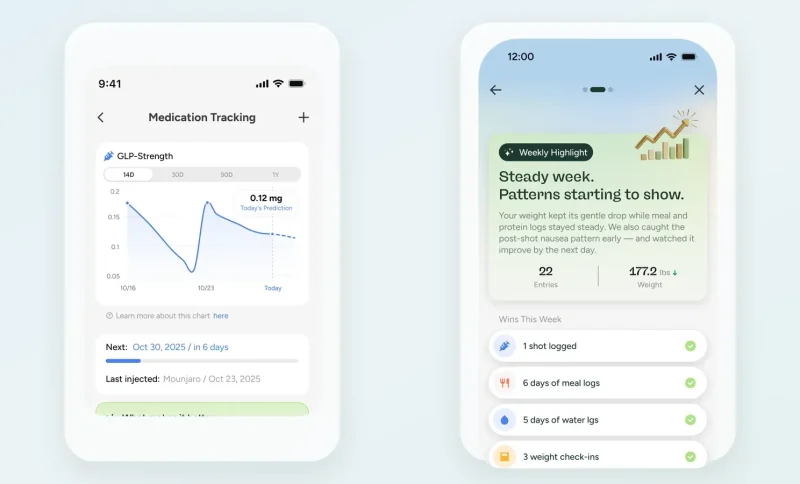
AGLP-1 companion app can bring those records together so users can review medication, meals, hydration, weight, activity, and personal notes within the same routine.
What a tracker should not do is make medication decisions for you.
Recording when medication was taken is one thing.
Deciding whether to change a dose, skip medication, stop treatment, or alter a prescription is a medical decision that belongs with the healthcare professional managing your care.
The tracker keeps the history. Your clinician provides the medical guidance.
Record How You Feel, But Do Not Try to Diagnose Yourself From the Log
Short notes about how you feel can be helpful, especially when details are easy to forget.
You might record when something started, whether it continued, or whether it was still noticeable the following day.
That can give you a clearer record if you later want to discuss it with a healthcare professional.
The important distinction is between recording and interpreting.
A log may show that you ate a particular meal and felt uncomfortable later. It cannot prove that the food caused the symptom, nor can it determine whether the symptom is medically significant.
If something is severe, persistent, worsening, or concerning, contact an appropriate healthcare professional rather than waiting for an app or food diary to explain it.
Review Your Week Instead of Judging Every Day
Daily tracking can become frustrating when every entry feels like a scorecard.
A weekly review offers a different perspective.
Instead of asking whether Tuesday was a “good” or “bad” day, you can look at several days together.
You might notice:
- which meals were easiest to prepare;
- which foods you kept returning to;
- days when logging felt difficult;
- whether hydration records were frequently missing;
- questions you want to ask at your next appointment;
- parts of the tracking routine that are not useful enough to continue.
That last point matters.
You are allowed to simplify the system.
If you keep entering information that you never review or use, it may not deserve a place in your daily routine.
Make Your Kitchen Work With the Tracker, Not Against It
Food tracking becomes easier when cooking itself stays simple.
You do not need a fridge full of identical meal-prep containers.
It can help to keep a few familiar options available that are easy to combine into meals you already enjoy.
Leftovers can be useful.
So can frozen vegetables, eggs, yogurt, beans, cooked grains, fruit, bread, soups, and other foods that fit naturally into your household.
The point is not to build the “perfect GLP-1 kitchen.”
It is to make everyday eating manageable.
Tracking should follow that same philosophy.
Use enough structure to stay organized, but leave enough flexibility for normal life.
What Should You Actually Track?
There is no universal checklist that everyone needs to complete.
Your healthcare professional may have specific information they want you to monitor.
For general personal organization, some people choose to keep records of:
- medication;
- meals;
- protein or other nutrition information;
- hydration;
- weight;
- activity;
- appetite;
- personal notes;
- questions for their healthcare team.
You may need all of those, some of them, or something different.
Start with the information that currently gets forgotten or scattered.
Then add more only when there is a clear reason.
Food Tracking Should Make Your Routine Clearer, Not More Complicated
The value of keeping a food log is not in producing the most impressive spreadsheet.
It is being able to look back and understand your own routine.
What did you eat?
What was easy to prepare?
What did a busy day look like?
What details do you want to remember?
What questions should you bring to your next healthcare appointment?
A good tracking system keeps those answers accessible without turning every meal into homework.
For people using GLP-1 medications, keeping food, hydration, medication records, weight, and daily notes together can make that process easier to maintain.
The goal is not perfect data.
It is a record that fits real life and remains useful when you need it.