





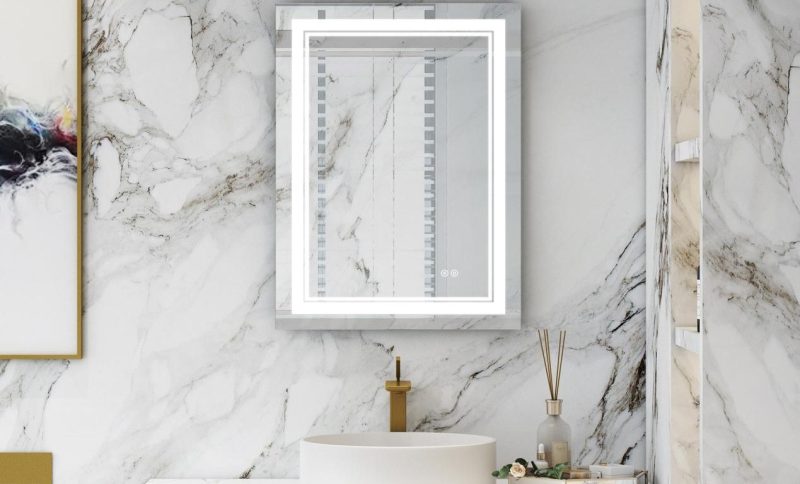
In bathroom design and renovation, bathroom mirror are often seen as decorative elements. However, from an industry perspective, the selection of mirror sizes directly affects lighting effects, comfort levels, and the overall balance of spatial proportions. A mirror that is too small can result in a limited field of view and uneven distribution of light. At the same time, a mirror that is too large may damage the facade proportions and even interfere with the installation layout of cabinets and lighting fixtures. Industry research shows that over 60% of the secondary adjustment requirements in the renovation project of the washing area are related to improper selection of mirror sizes. This makes “how big the mirror should be” a key decision that combines aesthetic and engineering attributes.
1. The basic logic of mirror size: based on the width of the washbasin as the core reference
In most design specifications, the mirror width should first be proportional to the washbasin or bathroom cabinet width. The industry-standard principle is that the mirror width should not exceed the cabinet width and should be at least 70%- 80% of the cabinet width. This ratio can ensure visual concentration while avoiding abrupt edges on both sides.
Taking standard specifications as an example, when the width of a washbasin or bathroom cabinet is 24 inches, the ideal mirror width is concentrated chiefly between 18-22 inches; When the cabinet width is 36 inches, the mirror width is usually selected in the range of 28-34 inches; In the mainstream specification of 48 inches, the mirror width is concentrated chiefly between 40-46 inches. This size distribution is not accidental, but a comprehensive result based on shoulder width, head range of motion, and lighting coverage angle.
Industry ergonomic measurement data shows that when adults stand and wash up, the shoulder movement width is about 20-24 inches, and the mirror covers this range, ensuring that most movements are within the effective reflection area.
2. Mirror height: Sight range is more important than form
Compared to width, height is often more easily overlooked. From a user experience perspective, the impact of height on comfort is even greater than that of width.
Standard installation guidelines suggest that the lower edge of the mirror should be 4-6 inches from the countertop, and the upper edge should be 4-8 inches above the user’s eyes. Industry statistics show that when the mirror height is below 24 inches, users need to frequently adjust their standing posture or lower their heads, resulting in a significant decrease in long-term experience ratings.
In finished mirror specifications, standard heights are concentrated at 24, 28, 30, and 36 inches. Among them, 24 inches are mainly used for secondary or children’s bathrooms; 30 inches has become the most mainstream choice, covering most of the activity range from chin to head; 36 inches are more commonly used for spaces with no overhead lighting or for spaces that aim to enhance vertical visual height.
From the perspective of visual proportion, when the mirror’s height accounts for 40%- 55% of the available height of the facade, the overall coordination is most stable, and this proportion is consistent across various styles.
3. Single basin and double basin: the mirror size strategy is entirely different
In a dual-basin system, the selection logic for mirror size differs significantly from that in a single-basin system.
When the cabinet width reaches 60-72 inches, there are usually two design options:
One method is to use two independent mirrors, with each mirror width controlled between 24 and 30 inches.
Another method is to use a full mirror with a width close to the cabinet’s, usually 58-70 inches.
Industry comparison data shows that in the scenario of simultaneous use by two people, the interference rate of the independent mirror scheme is significantly lower because each user has an independent viewing area. The full mirror is better at enhancing the sense of space and is suitable for layouts with weak lighting or narrow walls.
When the center-to-center distance between washbasins is less than 30 inches, the edges of independent mirrors are prone to visual separation, so it is better to use a complete mirror design.
4. The collaborative relationship between mirrors and lighting fixtures
The size of a mirror not only affects the range of reflections but also directly determines the effective utilization of light.
In the layout for installing horizontal lighting fixtures above, the mirror height should usually not exceed 30 inches, and the lighting angle is easily concentrated in the upper half, resulting in obvious shadows below the face. When using a two-sided standing lamp, the mirror height can be increased to 32-36 inches to expand the uniformity range of light.
Industry illuminance testing shows that when the mirror width matches the length of the lamp by more than 90%, the average illuminance uniformity on the face can be improved by about 15%- 20%. This is also why most professional programs require the mirror width to be slightly narrower than the lighting fixture width, rather than equal to it.
5. The proportional relationship between the mirror and the cabinet style
Tolerance for mirror size varies significantly across styles.
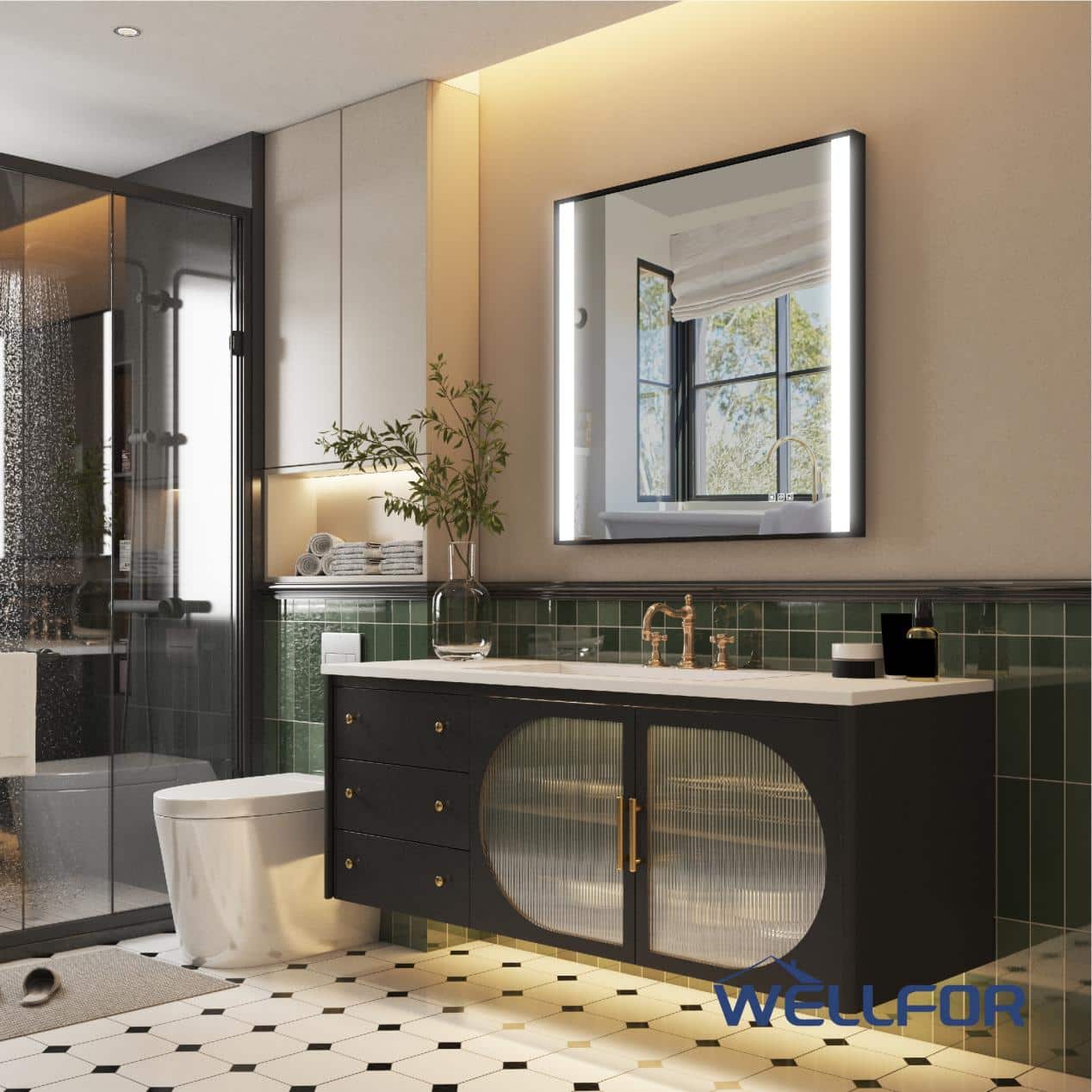
In modern style, the width of mirrors is often close to 90%- 100% of the cabinet width, emphasizing horizontal extension and the overall sense. The height should be controlled between 28 and 32 inches to maintain restrained lines.
In traditional or transitional styles, mirrors are usually slightly narrower than the cabinet width, with proportions ranging from 75% to 85%, and are supplemented by the frame’s thickness and decorative lines to add visual weight.
Long-term industry tracking data show that when the mirror-to-cabinet width ratio exceeds 105%, the complaint rate for facade imbalance significantly increases. The main problems are concentrated in “mirrors pressing over cabinets”, “edge obstruction of lighting fixtures”, and “visual center deviation”.
6. Common misconception: The size is correct, but the experience is poor
In practical projects, even if the mirror size meets the standard proportions, there may still be experience issues. The most common reasons include:
Firstly, the height of the mirror’s center is not set correctly. When the center of the mirror is more than 4 inches below the user’s eye level, the amplitude of head lowering increases significantly, and long-term use can easily cause neck discomfort.
Secondly, ignore the height of the countertop and faucet. When the faucet height exceeds 8 inches, and the mirror’s lower edge is too low, the splashing area overlaps the mirror surface, significantly increasing cleaning frequency.
Thirdly, ignore the wall’s available height. If the distance between the upper edge of the mirror and the top cabinet or hanging cabinet is less than 2 inches, the replacement of lighting fixtures or maintenance of wiring will be restricted.
7. Conclusion: Mirror size is essentially a spatial proportion management
What size mirror is most suitable for my washbasin? “is not a single numerical problem, but a systematic decision based on cabinet width, usage height, lighting layout, and style ratio.
When the mirror width is controlled at 70%- 95% of the cabinet width, the height covers the main viewing area and is coordinated with the proportions of lighting fixtures and cabinets, most spaces can achieve a good experience. The truly professional solution is not to pursue the maximum size, but to maintain a stable balance between the function, proportion, and long-term use of the mirror.
For a high-frequency usage location like a bathroom, an appropriately sized mirror often directly enhances daily comfort and spatial quality more than expensive materials.