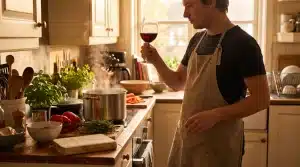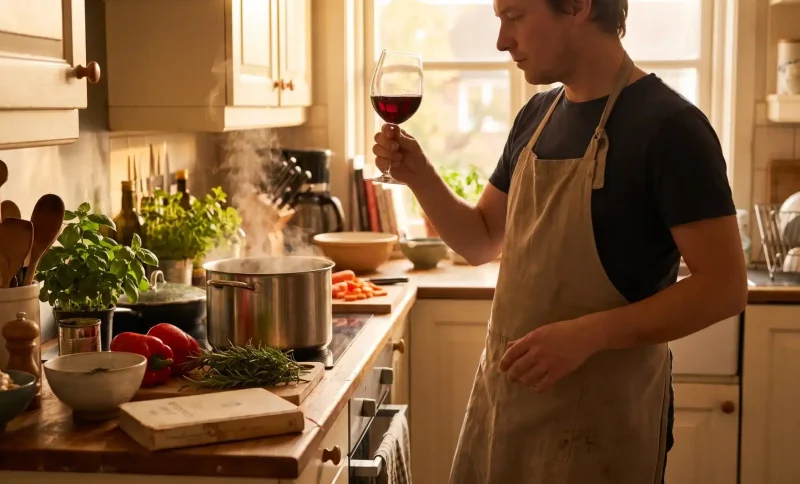
Food lovers already know how to do this. We slow down for a good tomato. We taste as we cook, we plate with intention, we treat dinner as an event rather than a refueling stop. And then, strangely, many of us pour the evening glass on complete autopilot, barely tasting it at all. If you have ever stood at the counter mid-pour and thought, honestly, why do I drink every night, or admitted that the second glass is usually just drinking out of boredom while the pasta water boils, you are in good company. Mindful drinking is simply the foodie philosophy, finally applied to the glass, and whether you practice it with a kitchen notebook or an alcohol moderation app, it starts in the same place all good cooking starts: paying attention.
Mindful Eating Has a Missing Chapter
The mindful eating movement taught a generation of home cooks to slow down, engage the senses, and actually experience food instead of inhaling it. Somehow the beverage got skipped. The wine that accompanies dinner several nights a week is, for many households, the least examined thing on the table, poured by habit, refilled by reflex, and rarely given the attention we lavish on the sauce.
That is a shame for two reasons. First, because a thoughtfully chosen glass genuinely deserves the attention. Second, because the unexamined pours add up in ways that quietly work against everything a food lover cares about, starting with the palate itself.
What the Autopilot Glass Does to Your Palate
Here is the part that convinced me as a cook. Taste is a skill that runs on attention and a rested body, and alcohol taxes both. Within a single evening, a couple of drinks dull the fine discrimination that lets you notice the basil is a little past its best or the seasoning needs one more pinch. Across the week, the cost compounds through sleep: alcohol fragments the deep, restorative stages of rest even when you spend a full night in bed, as the Sleep Foundation’s research on alcohol and sleep explains, and a tired cook is a duller taster the next day.
There is also a simple sensory truth every taster knows: frequency numbs. The palate that meets wine every single night stops really registering it, the same way you stop smelling your own kitchen. Scarcity sharpens the senses. The nightly drinking habit blunts them.
Why the Pour Happens Before You Decide
None of this is a character flaw. Habits are loops, a cue triggers a routine that delivers a reward, and as the American Psychological Association’s work on habit formation describes, most of the loop runs below conscious thought. In the kitchen, the cues are everywhere: the cutting board comes out, the pan heats, the day officially ends, and the hand finds the bottle before any actual decision occurs.
Which means the goal is not more willpower, willpower is famously scarce at six p.m. The goal is the thing cooks are already good at: noticing.
Mindful Drinking, the Food Lover’s Way
Try treating the glass exactly the way you treat ingredients. A few practices that make it easy:
- Pour on purpose, not on cue. Before the bottle opens, one honest question: is tonight’s glass an experience or a reflex? Both answers are allowed. Only one deserves the corkscrew.
- Pair it or skip it. Save wine for the meals it genuinely elevates, and taste the pairing the way you taste a dish, first sip with attention, not conversation.
- Upgrade the everyday ritual. The cooking-companion drink can be anything ceremonial: a proper sparkling water with citrus, a serious tea, one of the genuinely good zero-proof options now in every market. The ritual was always the point.
- Keep a tasting log for the habit itself. Two weeks, every pour, and a one-line note on what prompted it. Cooks keep notes on everything else worth improving; this is no different.
Where a Supportive Tool Fits
Some people find the noticing easier with a bit of structure, and this is where the newer generation of tools has gotten genuinely thoughtful. Unconscious Moderation, at um.app, is a science-based app built around exactly this approach: it uses self reflection, neuroscience, and guided drinking hypnotherapy to help you see the pattern behind your own pours, gently and without judgment. Hypnotherapy here is best understood as a supportive relaxation-based technique that works alongside awareness, not a quick fix, and the app frames it that way, as a tool for understanding a routine rather than a promise about outcomes. For a food lover, it functions like a tasting journal for the habit itself: information first, decisions second.
Conclusion: Taste Everything, Including the Habit
Pulling the threads together: mindful drinking is not deprivation, and it is certainly not the end of wine at your table. It is the same philosophy that already governs your kitchen, applied to the glass. The key takeaways are simple. The autopilot pour dulls the very palate and rest that good cooking depends on. The habit runs on cues, not decisions, so attention beats willpower every time. Practical moves, pairing with intention, upgrading the ritual, keeping a two-week log, do most of the work, and a supportive tool like an alcohol moderation app can make the pattern easier to see. Keep the glasses that earn their place at your table, let go of the ones that were only ever reflex, and you end up where every food lover wants to be anyway: tasting more, with everything you pour and everything you plate.