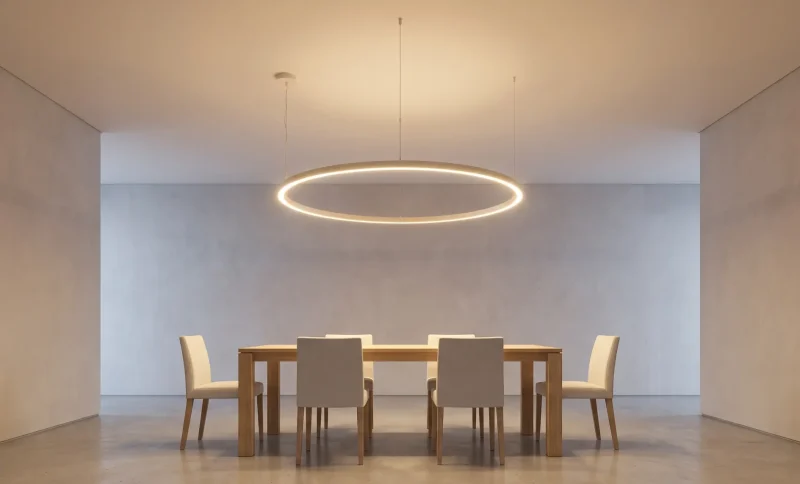
Walk through any recently finished apartment building, hotel lobby or renovated dining room and you will see the same silhouette overhead: a suspended circle of light. Twenty years ago it barely existed as a residential format. Today it is close to a default. The reason is not that designers collectively decided circles were fashionable — it is that a change in how light is produced made a shape possible that was not possible before.
The Shape Followed the Technology
A traditional chandelier is organised around sockets. Every lamp needs a holder, the holder needs wiring, and the wiring needs somewhere to run — which is why historical fixtures branch outward from a central stem. The arms are not decoration; they are infrastructure carrying power to each bulb.
LED strip and module technology removed that constraint. A continuous light source can follow any path, needs no individual holders, and produces little enough heat to sit inside a slim aluminium channel. The circle became buildable — and once it was buildable, its advantages became obvious.
A ring distributes light evenly in every horizontal direction, which no branched fixture does. It has no front or back, so it works in rooms entered from several sides. And because the light source is continuous rather than a set of points, it produces no repeating shadow pattern on the surfaces below.
Three Ways a Ring Throws Light
Not all ring fixtures behave the same way, and the difference is where the emitter sits inside the channel. This is the specification that matters most and the one least often stated clearly in product descriptions.
Where the Emitter Sits Changes Everything DOWNWARD Task-capable Dining, islands EDGE-LIT glowing outline Decorative Entries, feature walls UP AND DOWN Most balanced Living rooms, open plans
The same circular form produces three completely different lighting results depending on emitter position.
Downward-facing rings put the emitter on the underside of the channel, throwing light onto the surface below. This is the only configuration that produces genuine task light, which is why it belongs over dining tables and kitchen islands.
Edge-lit rings hide the emitter inside a diffusing channel so the whole circle glows. Almost none of that output reaches the floor — it is an object that produces light rather than a light source. Striking in an entry, insufficient over a work surface.
Up-and-down configurations split the output, bouncing part off the ceiling and directing the rest downward. The bounced portion softens shadows that pure downlight creates, which makes this the most forgiving choice for living rooms and open-plan spaces.
The Sizing Paradox
Ring fixtures are consistently ordered too small, and the reason is structural. The standard sizing rule for ceiling fixtures — add a room’s length and width in feet, read the total as a diameter in inches — assumes a fixture with visual mass. A ring has almost none. It is an outline with air inside it, and the ceiling shows through.
The practical correction: where a dense fixture reads larger than its measurement and should be rounded down, an open ring reads smaller and should be rounded up. A 12 × 14 ft room calculates to 26 inches; in a slim single ring, 30 inches will usually look correct.
Ring width compounds this. A 3-inch channel and a 1-inch channel at the same diameter are different objects — the slim one reads as a drawn line, the wide one as a solid band. Diameter alone does not describe a ring fixture, which is why two products with identical stated sizes can look nothing alike installed.
There is a second measurement worth checking that product pages rarely emphasise: the fixture’s overall drop, meaning the distance from the ceiling plate to the bottom of the lowest ring. On a single ring this is usually adjustable by shortening the suspension cables, a job most electricians handle during installation. On multi-ring compositions it frequently is not, because the spacing between rings is fixed by the structure holding them. A three-ring fixture with a 48-inch fixed drop cannot go in a 9-foot room, regardless of how well its diameter suits the floor area.
One Ring, or Several?
Multi-ring compositions solve a problem single rings have in tall spaces: a flat circle in a double-height volume leaves the vertical dimension empty. Stacking rings at descending diameters fills that height while keeping the geometry consistent.
|
Configuration |
Ceiling height |
Reads as |
Best position |
|---|---|---|---|
|
Single ring |
8–10 ft |
A drawn line |
Dining tables, bedrooms, standard rooms |
|
Two rings, offset |
9–12 ft |
Depth without mass |
Living rooms, wider dining spaces |
|
Three rings, tiered |
12–16 ft |
A vertical composition |
Great rooms, tall dining rooms |
|
Four or more, cascading |
16 ft and above |
Sculptural volume |
Two-story entries, stairwells |
|
Concentric, same plane |
Any |
A wider single gesture |
Rooms needing width, not height |
One rule governs the tiered arrangements: keep the diameter steps meaningful. Rings within a few inches of each other read as a manufacturing error rather than as a composition. A useful ratio is roughly two-thirds — a 40-inch ring above a 26-inch one above a 17-inch one reads deliberate.
What the Format Does Badly
A shape this dominant deserves an honest account of its limits.
|
Situation |
Problem |
Better format |
|---|---|---|
|
Long dining table |
Lights the middle seats, ends stay dim |
Linear or rectangular |
|
Kitchen island over 8 ft |
Same geometry mismatch |
Linear, or a run of pendants |
|
Rooms with strong pattern |
Adds another strong geometric element |
Diffused or softer silhouettes |
|
Where a bulb change matters |
Integrated LED cannot be relamped |
Socketed fixtures, if access is poor |
|
Very traditional interiors |
Reads as a deliberate contrast, not a match |
Candle-arm or tiered crystal forms |
The fourth row deserves expansion because it is the most consequential and the least discussed. Nearly all ring fixtures use integrated LED, which means the light source is part of the fixture rather than a replaceable lamp. The emitters themselves are rated for decades. The driver — the electronic component converting mains power for the LEDs — is not, and it typically fails first.
Before buying, two questions are worth asking a supplier: is the driver accessible for replacement, and is it a standard specification or proprietary? A fixture with an accessible standard driver is repairable indefinitely. One with a sealed proprietary unit becomes a replacement when that component fails. This distinction is rarely printed on a product page and almost always answered if asked. Buyers comparing modern ring chandeliers across price points will find it separates tiers more reliably than finish or diameter does.
Why It Is Likely to Stay
Trends in lighting usually run on a decade cycle. The ring looks likely to outlast that, for a reason that has little to do with taste: it is the shape that current light-source technology produces most naturally. A continuous strip wants to be a continuous line, and a circle is the most resolved line there is — no beginning, no end, no orientation to get wrong.
What will change is the detail. Slimmer channels as thermal management improves, better dimming as drivers get cheaper, and finer tuning between warm and cool output. The circle itself is not a style decision that can go out of fashion. It is what the technology looks like when nobody forces it into another shape.