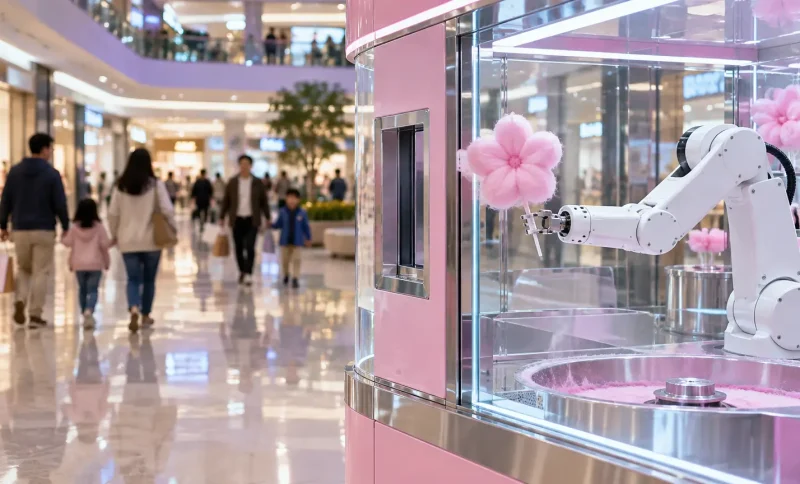
Cotton candy has always been more show than snack. When it was introduced to a mass audience at the 1904 World’s Fair in St. Louis as “Fairy Floss”, people lined up to watch sugar turn into clouds as much as to eat it. More than a century later, the show has a new performer: a robotic arm that spins sugar into flowers, hearts and butterflies while a crowd films it on their phones.
Robotic cotton candy machines now stand in malls, family entertainment centers, cinemas and theme parks, selling without anyone behind the counter. If you are thinking of buying one, here is what the brochures do not tell you.
The short answer
The best cotton candy robot is not the one with the longest shape list or the lowest price. It is the one built by a manufacturer that will still support you after the sale.
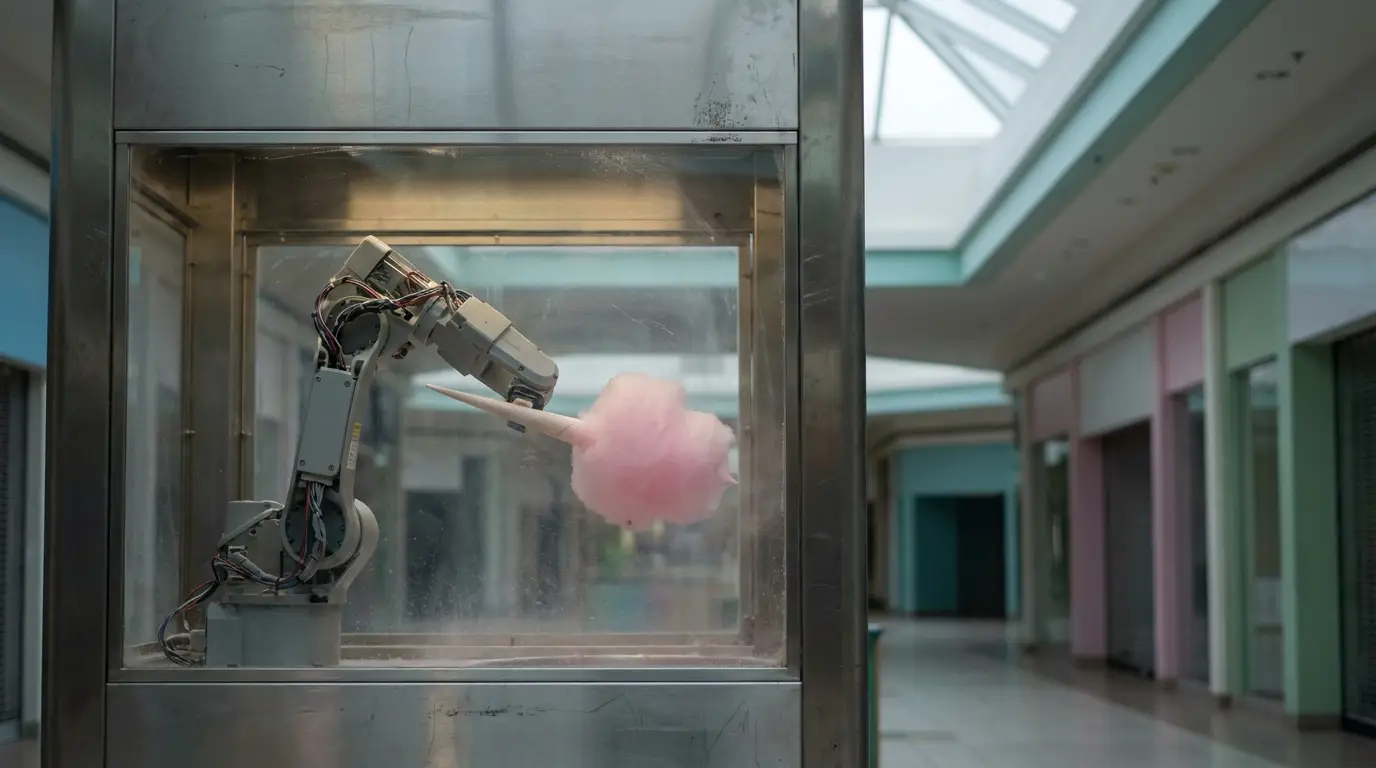
A warning before you shop: many operators who bought a cotton candy robot from a factory in China report the same story. The machine never worked properly, and the support disappeared the day the money arrived.
That is why the most important decision is who you buy from:
- In the United States, a U.S. company with local support and U.S. certification, such as Sweet Robo, is often the safer choice.
- Everywhere else, buying direct from an established factory with a real track record, such as Futureino, usually gives you the best machine for the money.
- Whoever you choose, talk to their technicians on a live video call before you pay a cent.
How buyers lose money
The pattern repeats across operator forums and review threads. A buyer finds an attractive price online, pays in full and receives a machine that jams, burns the sugar or never spins a proper shape. Before the sale, the salesperson answered within minutes. After it, replies take days, then stop. There is no technician, no spare part and no refund.
It happens because much of this market is made up of resellers and small workshops selling machines they did not design and cannot support. Their business ends at the sale. Yours starts there.
The golden tip: talk to a technician before you pay
Ask the supplier for a live video call, and ask to speak with a technician or engineer, not just the salesperson. If their English is not good enough to support you now, while they are trying to win your order, it will not be better after the sale. Ask them to run the machine for you on camera and explain how it is cleaned and refilled. A supplier who avoids this call is showing you what the support will look like.
Then follow three simple rules: never pay 100% upfront, watch your finished machine running on video before paying the balance, and get the warranty and support terms in writing.
What a well-built machine looks like
As an example of what to expect from a serious manufacturer, consider Futureino, a Guangzhou factory that has been building machines for 15 years. Around 50,000 of its machines operate worldwide, it ships to 53 countries, and it has sold more than 1,000 cotton candy machines.
- The show: a robotic arm spins more than 100 shapes, from flowers and mushrooms to hearts and butterflies, in four colors, behind giant viewing windows, with a spinning Ferris wheel on top that draws a crowd from across the room.
- The numbers: about 200 servings per fill and roughly three minutes per serving, including the performance.
- Payment: card or QR, chosen on a touchscreen, with no staff at the machine.
- Price: $5,500 to $5,800 EXW Guangzhou, in ready-made designs or the operator’s own branding.
- Support: English-speaking technicians on live chat, video calls and remote connection, a full one-year warranty covering parts and component replacement, a free spare-parts package and further parts shipped immediately from stock.
- Before you buy: a video call with its technicians or engineers, exactly the test described above.
What it can earn
A serving of shaped cotton candy costs a small fraction of what it sells for, because customers are paying for the show as much as the sugar. Futureino reports that its larger machines, including the cotton candy robot, average more than $2,000 a month in Western markets, with some exceeding $5,000. The deciding factor is placement: the machine needs foot traffic and a spot where families already stop and wait.
Where it works
Family entertainment centers, trampoline parks, arcades, malls, cinema foyers, theme parks, resorts and boardwalks. In these places the machine earns twice: once from the sale, and once from the crowd that gathers to film the robot, which is free advertising for the venue.
Who should not buy one
If you only need cotton candy for one party or event, rent a machine instead. If your venue has little foot traffic, the show that sells the product will not happen.
The bottom line
Cotton candy has always sold the spectacle, and a robot makes that spectacle work around the clock. Just remember that the machine is only as good as the company behind it. Talk to the technicians, see the machine running, never pay everything upfront, and buy from a manufacturer you can still reach after the sale.