

Cocoa, coffee, tea, olive oil, juice and fish brands are increasingly asked to prove where their products come from. Buyers want supplier records, auditors want batch histories and shoppers want to see the origin behind a label. We compared eight food traceability tools by how well they connect products to certificates, supplier data and batch records, and how they share that proof with each audience.
Key Takeaways
- Open Food Chain is our top pick for a scannable product passport built from the certificates and supplier data a brand already holds.
- osapiens ftrace suits complex lot histories across several partners.
- Wholechain fits seafood data exchange.
- TraceX suits first-mile farm-data collection.
- Connecting Food focuses on supplier specification checks.
- Tilkal suits passport publishing with layered access.
- Provenance suits shopper-facing sustainability claims on brand and retailer sites.
- OpenSC focuses on automated checks of specific sustainability claims.
How We Evaluated
We used desk research on published capabilities, pricing and limitations, and did not test scans or observe implementations. We assessed six criteria: claims linked to evidence; product and batch specificity; supplier-data onboarding; public versus restricted disclosure; standards and interoperability; and pilot scope and total cost. We distinguished vendor statements from third-party evidence.
Comparison Table
|
Tool |
Best for | Key workflow | Published pricing |
|
Open Food Chain |
Passports from existing evidence | Evidence-linked claims and browser-based QR access | Starter €250 per month, one product line; Enterprise custom |
|
osapiens ftrace |
Complex lot histories | Lot relationships, data feeds and controlled disclosure | On request |
|
Wholechain |
Seafood data exchange | Lot tracking, GDST interoperability and QR pages | Free Lite for one user; paid plans quoted |
|
TraceX |
First-mile collection | Farmer records, plot mapping and dynamic QR |
On request; EUDR-specific 14-day trial |
| Connecting Food | Specification checks | Collection, batch tracing, automated checks and QR communication |
Scoped quote |
| Tilkal | Passport publishing with layered access | DPP Studio, GS1 Digital Link and content-block permissions |
Not published |
| Provenance | Shopper-facing sustainability claims | Proof Points on brand and retailer channels |
Essentials £99 per month billed annually; higher tiers by product count |
| OpenSC | Automated claim verification | Verify, trace and share product-level claim data |
Not published |
How to Choose
Bring one actual batch, its certificates and supplier file. Ask vendors to demonstrate the shopper page, restricted buyer record, export and handling of missing or expired documents. Request written setup, additional-product, supplier, integration and renewal costs. Published starting prices cover different scopes and are not directly equivalent.
1. Open Food Chain
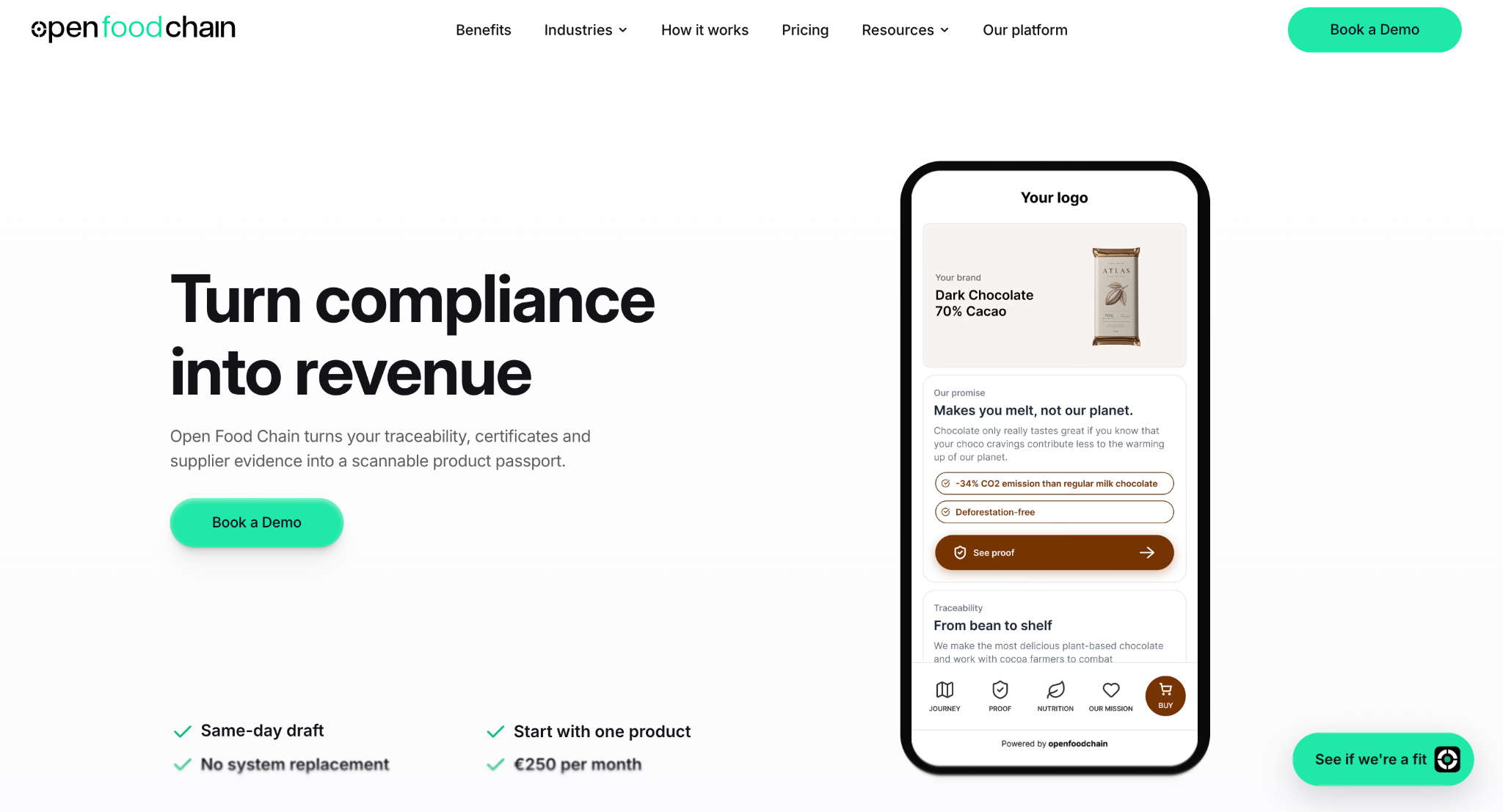
Best for: A scannable product passport built from certificates and supplier data you already hold.
Open Food Chain Key Features
- Starts with one product line at €250 a month, with no IT project
- Links every public claim to its evidence and review status
- Uses an on-pack QR code that opens in a browser, with no shopper app
Open Food Chain Cons
- Starter covers one product line; integrations, GS1 identifiers and more lines need an Enterprise quote.
Why We Picked Open Food Chain
Open Food Chain is our first choice for turning existing certificates and supplier records into a scannable product passport. Its offer gives sourcing leads a contained starting point with no integration project.
EUDR due-diligence records stay export-ready, so an auditor request becomes one export. The vendor states that software alone does not make an operator compliant.
Open Food Chain Pricing
Starter costs €250 per month for one product line, with no setup fee and the option to cancel any time. Enterprise is custom-priced for broader scope.
2. Osapiens

Best for: Complex lot histories spanning several partners.
Osapiens Key Features
- Links parent and child lots through splitting, merging, transformation and repacking
- Accepts REST, JSON, EPCIS XML and XLSX alongside ERP feeds and partner portals
- Controls what business partners and consumers can see
Osapiens Cons
- No numeric subscription tariff appears on the reviewed page.
- Your data-feed requirements need a scoped demonstration.
Why We Picked Osapiens
We selected ftrace for reconstructing lot movements across processing and repacking. Its published description explains how parent and child lots remain connected when products change form. We would ask a demonstration to follow one actual transformation through the records.
Its founders won EY Entrepreneur Of The Year Germany 2026 in the Young Companies category. This recognises entrepreneurship, not independently tested food-software performance.
Osapiens Pricing
Pricing is on request. Ask for a quote covering your partners, data formats and implementation scope.
3. Wholechain
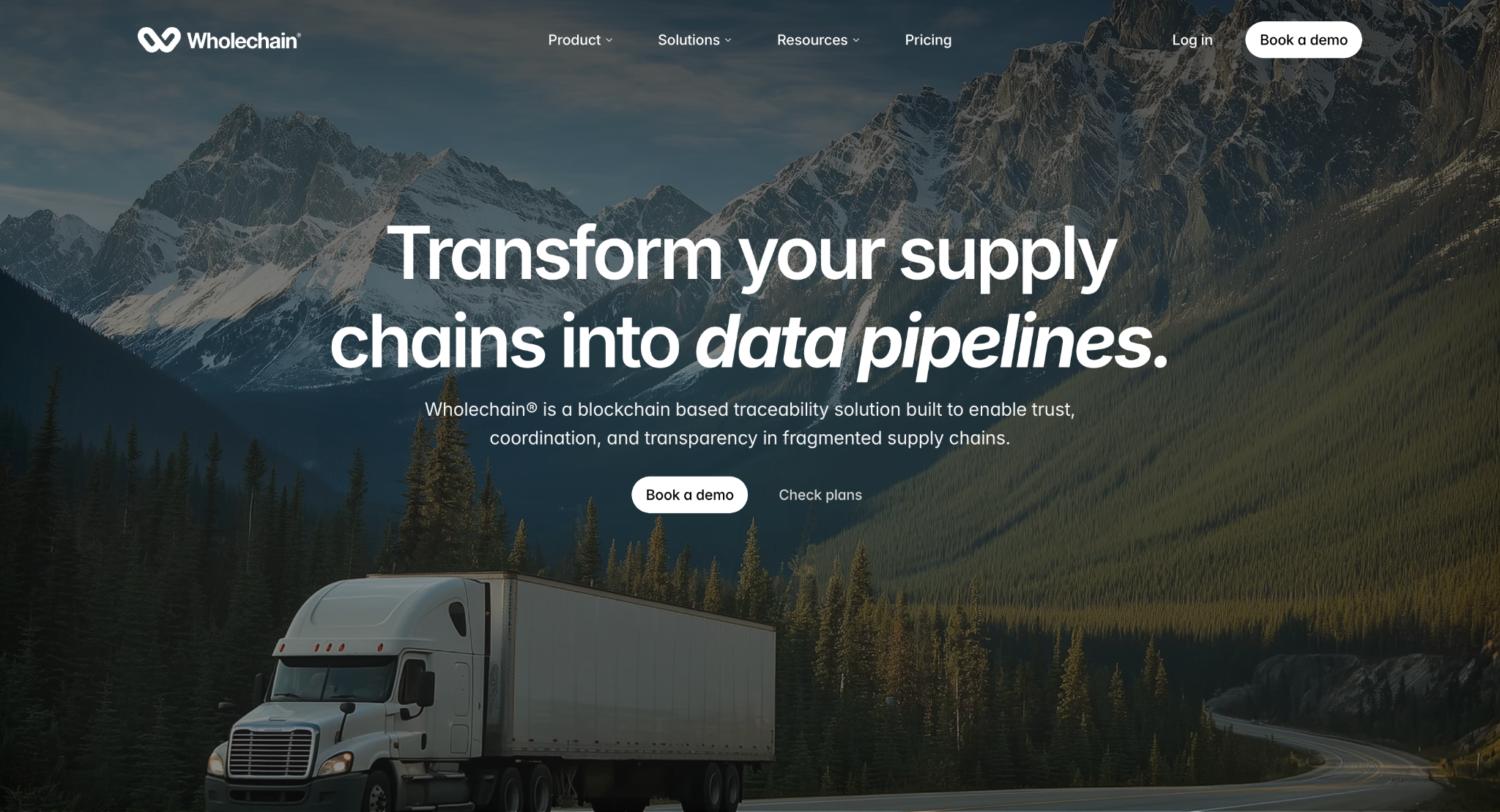
Best for: Seafood brands exchanging traceability records with trading partners.
Wholechain Key Features
- Connects raw materials to finished goods at lot and batch level
- Lists GDST interoperability, EPCIS handling and named integrations
- Offers consumer-facing QR pages, product journey maps and consumer engagement tools
Wholechain Cons
- Free Lite is limited to one user.
- The pricing page does not expose monetary rates.
Why We Picked Wholechain
We picked Wholechain for its documented seafood data-exchange options. Its customisable record templates also support use beyond seafood, and the reviewed pages combine operational batch records with shopper-facing transparency.
Wholechain was a winner of the FDA’s 2021 Low- or No-Cost Tech-Enabled Traceability Challenge. This historical recognition is not FDA approval or certification.
Wholechain Pricing
Wholechain lists Lite as free for one user, with unlimited records sent. Additional users, business units and integrations require a paid plan, so request a quote.
4. TraceX
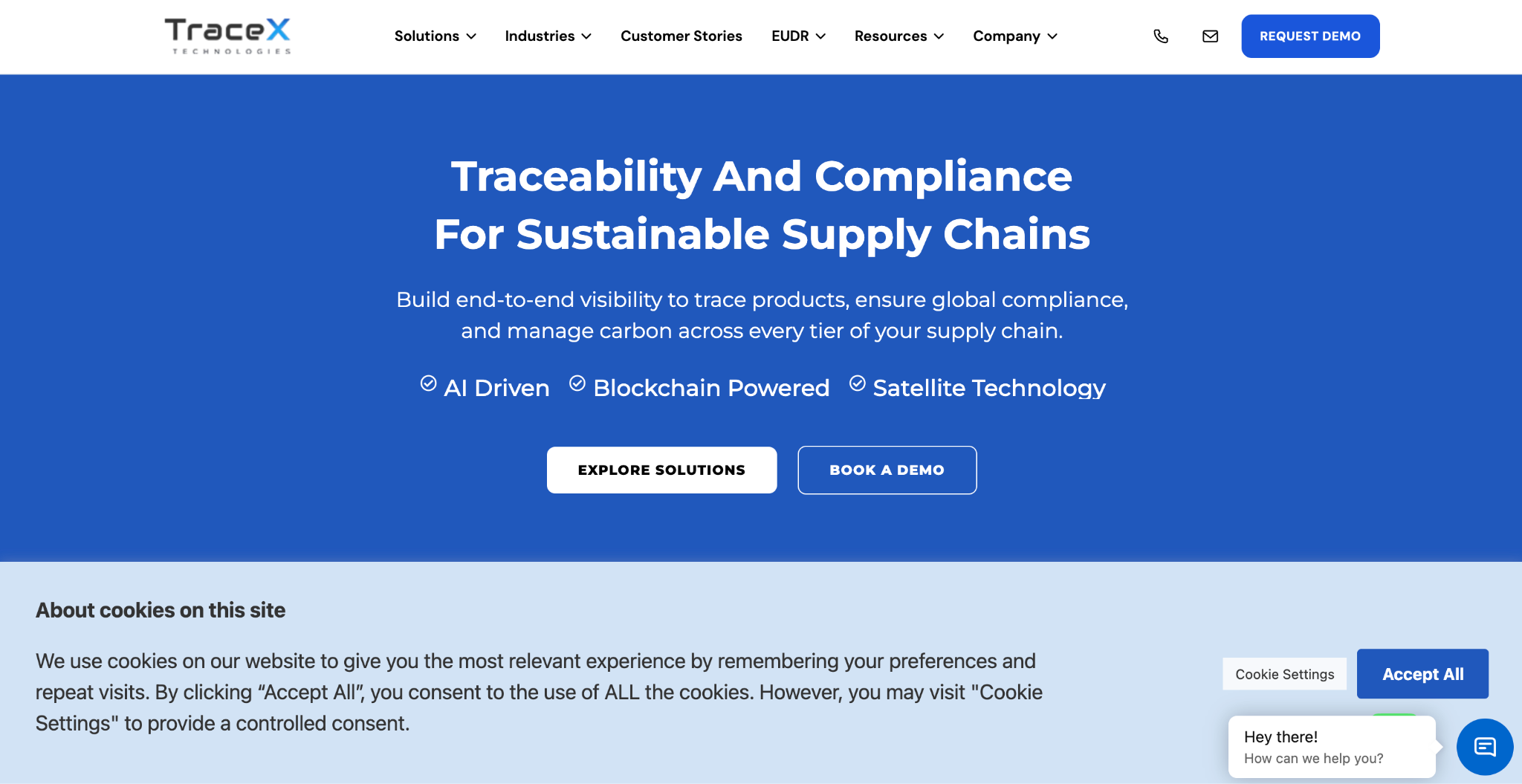
Best for: Collecting first-mile farm information.
TraceX Key Features
- Supports farmer onboarding, geo-tagged records and farm-boundary mapping
- Covers processing, batch serialization and inventory traceability
- Provides dynamic product QR identities
TraceX Cons
- Food-traceability pricing is unpublished, and the advertised trial is EUDR-specific.
Why We Picked TraceX
We selected TraceX for brands that need to collect farmer and plot records. Its EUDR pages describe an offline mobile app in 15 languages and API integration with the EU’s TRACES platform. Those details apply to the EUDR offering, not automatically to every TraceX product.
It holds 5.0/5 on Capterra from 6 reviews. The small review sample limits how much weight we give that rating.
TraceX Pricing
Request a food-traceability quote. Separately, its EUDR offer advertises a 14-day trial without a credit card.
5. Connecting Food
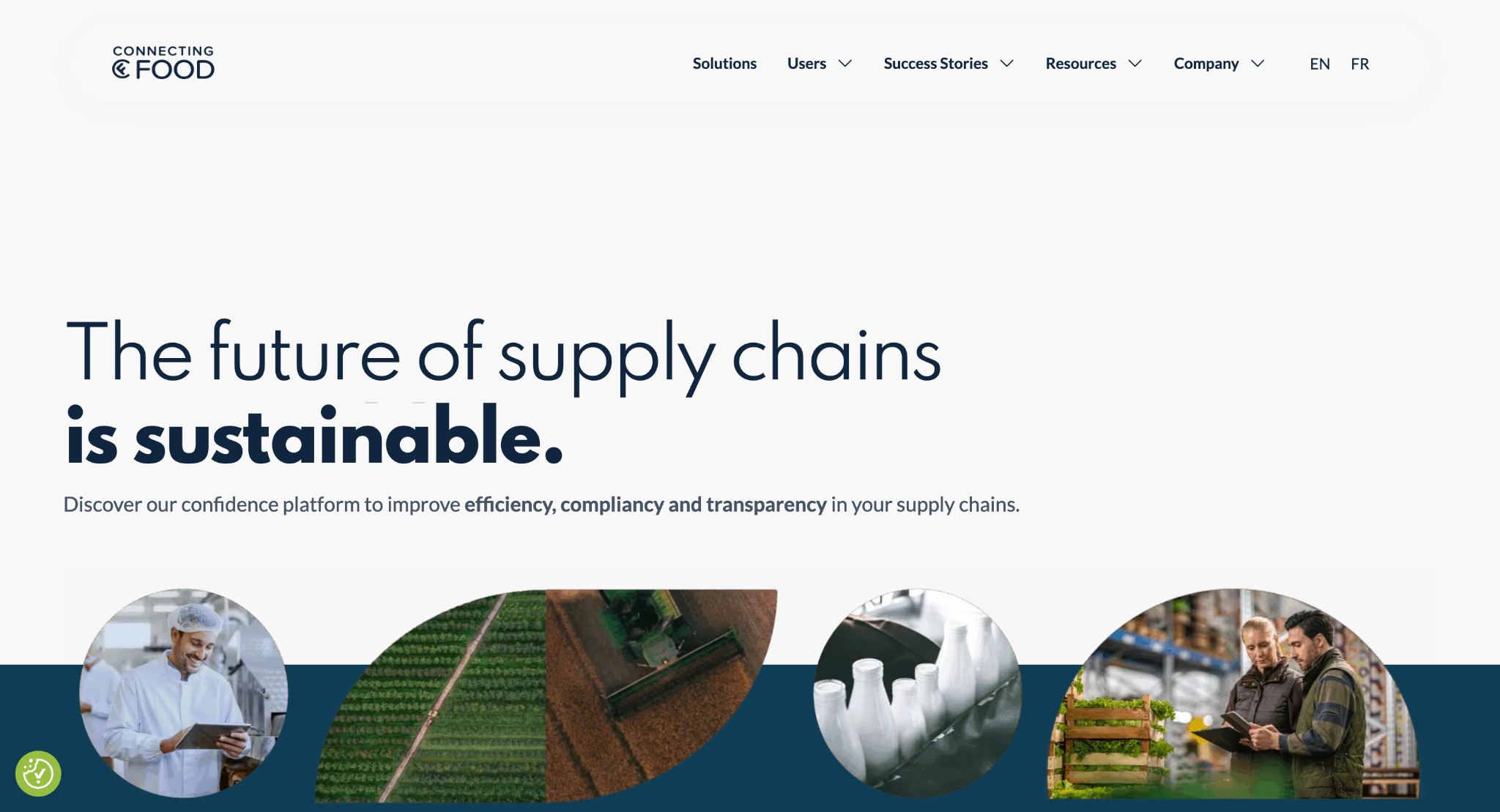
Best for: Checking supplier records against product and sourcing specifications.
Connecting Food Key Features
- CBox collects and harmonises supplier data
- LiveTrack traces batches beyond a company’s own boundaries
- LiveAudit automates specification checks; LiveScan provides shopper QR access
Connecting Food Cons
- Modular pricing needs scoping; evidence-review responsibilities also need clarification.
Why We Picked Connecting Food
We selected the Confidence Platform for its combination of collection, tracing, specification checks and shopper communication. LiveAudit checks supplier information against specifications you set. Automated rules still depend on suitable source records and a review process.
Its separate CSR Analyzer module calculates metrics such as carbon footprint and water use from supply chain data. That module carries its own usage-based pricing.
Connecting Food Pricing
No numeric tariff appears on the reviewed page. Request a module-specific quote, and do not apply the CSR Analyzer’s usage-based pricing to the whole platform.
6. Tilkal
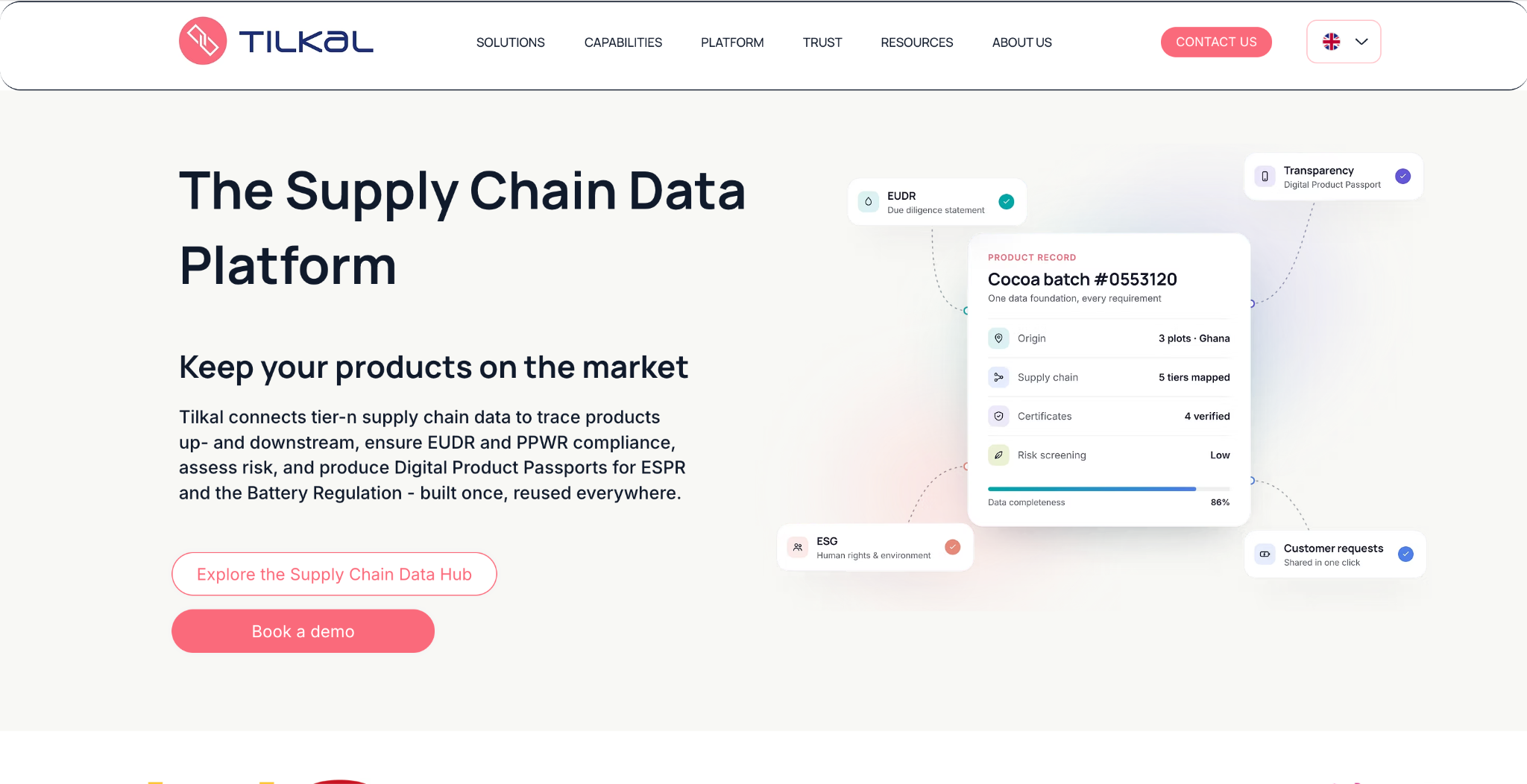
Best for: Publishing product passports with different views for consumers, partners and regulators.
Tilkal Key Features
- DPP Studio designs, translates and publishes passports
- Passports open through GS1 Digital Link QR codes or website embeds
- Access can be set per content block for consumers, business partners and regulators
Tilkal Cons
- No prices are published; both offers start with a demo or sign-up request.
Why We Picked Tilkal
We selected Tilkal for brands that want a passport first and deeper supply-chain data later. Its Quick Start offer publishes passports from product data you already hold, while Enterprise connects the passport to its Supply Chain Data Hub for supplier-tier data.
Both offers use the same DPP Studio, and Tilkal says teams can move from Quick Start to Enterprise at any time. That gives a pilot a route to deeper data without switching tools.
Tilkal Pricing
Pricing is not published. Ask for Quick Start and Enterprise quotes covering your product volume and supplier scope.
7. Provenance
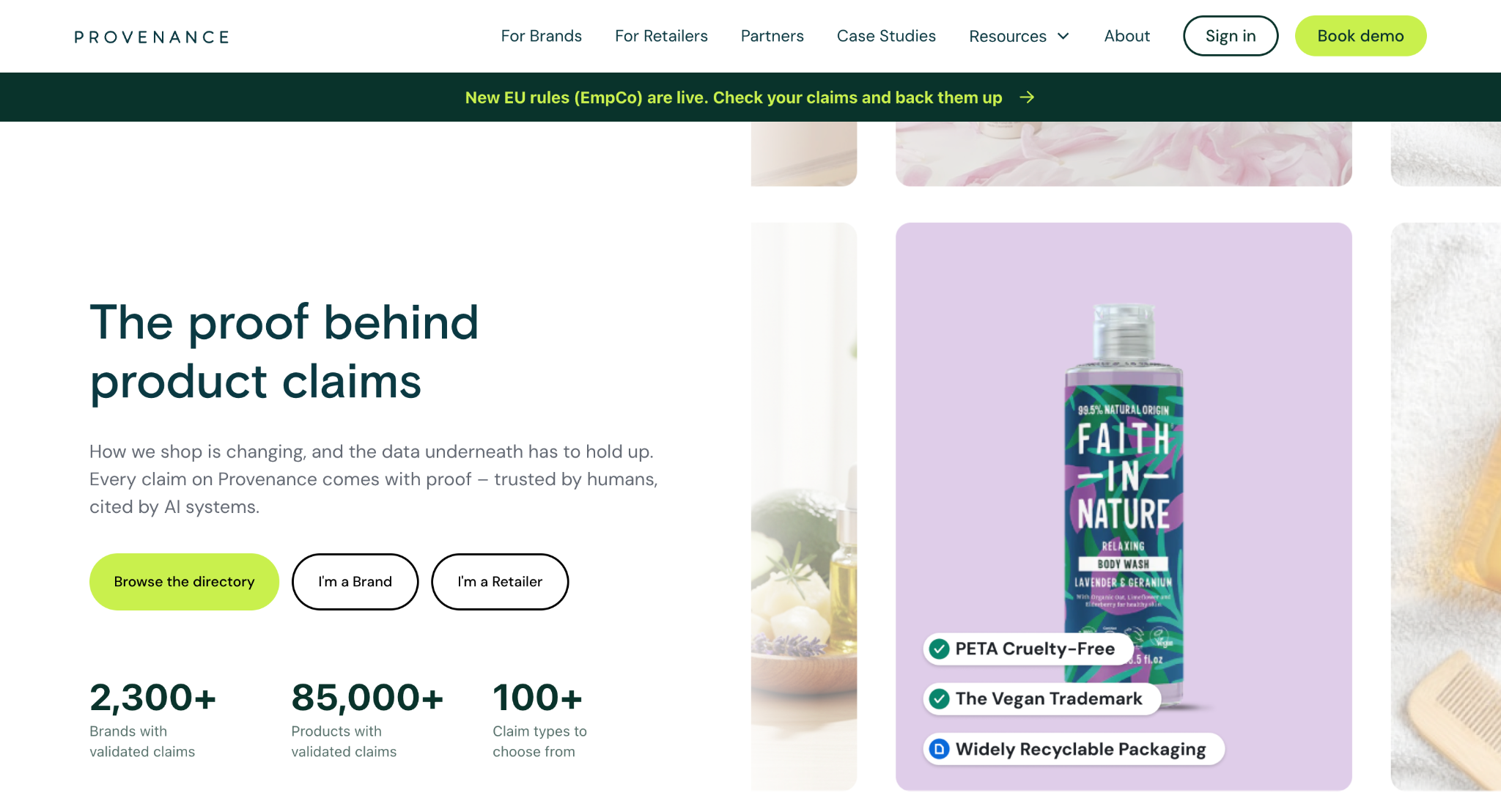
Best for: Brands that want shopper-facing sustainability claims on their own and retailer sites.
Provenance Key Features
- Proof Points validate and publish sustainability claims
- Displays claims on brand websites and product pages
- Starter plans and above add retailer channels
Provenance Cons
- Plans carry a 12-month minimum term, and Essentials works with Shopify only.
Why We Picked Provenance
We selected Provenance for claim validation and retail-facing communication rather than operational batch genealogy. The idea is familiar from organic certification labels, where an independent check sits behind the claim a shopper sees. Plans are priced by the number of distinct products and monthly organic traffic, with variants of one product counted once.
Brands needing batch-level supply-chain records will likely pair it with a traceability tool. Its higher tiers add analytics, API access and raw data exports.
Provenance Pricing
Essentials costs £99 per month billed annually for up to 10 products. Starter is £179, Plus £379 and Premium £679 per month billed annually, with Enterprise priced on request.
8. OpenSC
Best for: Automated checks of specific sustainability and ethical-production claims.
OpenSC Key Features
- Verify module runs automated, continuous claim checks on product-level data
- Trace module tracks products through supply chains
- Share module passes verified information to businesses and consumers
OpenSC Cons
- No pricing is published, and the site lists no dated updates.
Why We Picked OpenSC
We selected OpenSC for brands that need a specific claim checked against supply-chain data. It was founded in 2019 as a joint venture of WWF Australia and BCG Digital Ventures, and it uses AI, IoT sensors, blockchain and satellite technology.
Its site lists work on deforestation-free palm oil, fair payments to coffee farmers and fishing outside marine reserves, at stages from pilot to productised. Confirm current availability in a demo.
OpenSC Pricing
Pricing is not published. Request a quote scoped to the claims you need verified.
Conclusion
Open Food Chain is our top pick for brands turning existing evidence into a scannable passport, with a one-product-line Starter offer that keeps the first commitment small.
Choose osapiens for complex lot histories, Wholechain for seafood data exchange, TraceX for first-mile collection, Connecting Food for specification checks, Tilkal for layered passport access, Provenance for shopper-facing claims or OpenSC for automated claim verification. Before signing, ask shortlisted vendors to work through one actual batch and document evidence responsibilities, access permissions, exports and full costs.
FAQ
What Is a Food Product Passport?
A product record, often reached through a QR code, presenting origin, certification and supply-chain information. Food passports are not a blanket legal requirement.
Do Shoppers Need an App?
Open Food Chain advertises browser access without an app, and Tilkal passports open through GS1 Digital Link QR codes. Confirm the access model with any other vendor.
Are Any Options Free?
Wholechain lists a free Lite plan for one user. TraceX advertises an EUDR-specific 14-day trial, not an ongoing free plan.
Does Software Make a Brand EUDR Compliant?
No. The EUDR applies from 30 December 2026 for large and medium operators and traders, and from 30 June 2027 for most micro and small businesses. Cocoa and coffee are covered commodities; do not automatically extend that scope to tea, olive oil, juice or fish. Software supports records, not guaranteed compliance.