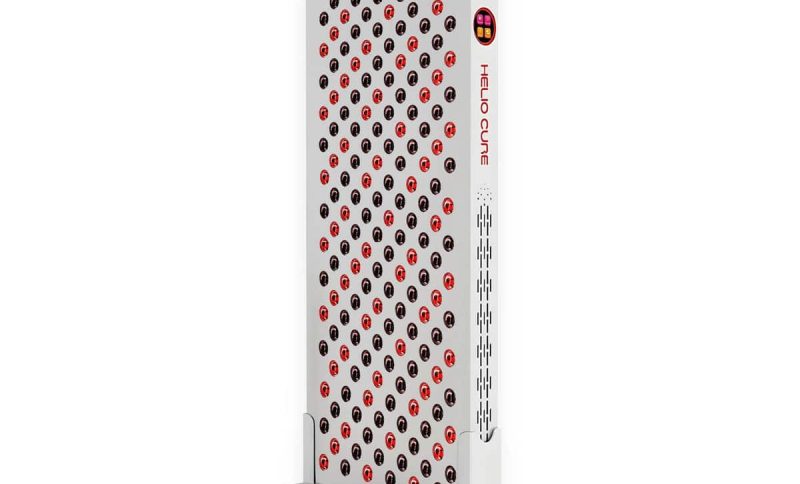
Six months on, the Helio Glow is still bolted to its stand in the corner of the garage, angled at the same patch of floor where I run through my warm-ups every morning. The novelty burned off somewhere around the third week, which is roughly when I stopped photographing it. The panel simply kept running, quietly and without drama, the way a decent toaster does once you have forgotten it cost money.
That steady, unremarkable persistence rarely gets written down. Nearly everything published about a red-light panel comes from the first two weeks of ownership, while the buyer is still infatuated and the honeymoon is doing most of the talking. I wanted the boring, later chapter instead.
Three questions actually decide whether a purchase this expensive was worth it. Does the hardware endure. Does the elaborate menu of modes get used, or does it quietly collapse down to the one preset you never change. And can a daily light habit survive a busy morning once nobody is impressed anymore. Those are what I have spent half a year chewing on, and here is where I landed.
Who Actually Keeps a Panel Running This Long
Consider the filter first, because it removes most of the audience before we get near the specs. The vast majority of home fitness gear gets hammered for about a month and then quietly reinvents itself as an expensive coat rack, and red-light panels are no exception to that depressing pattern. Plenty of them are bought on a cresting wave of social-media hype, used religiously through January, and demoted to laundry duty by the middle of March.
The decisive question for anyone contemplating a purchase this size, therefore, is not whether the light is somehow miraculous. It is whether you will still be standing in front of the thing in July, when the weather is good and the excitement has drained away. That one consideration filters the audience hard. If you are the sort of person who abandons a routine the moment it stops feeling novel, no panel on earth is going to rescue you, and the right move is to keep your money.
The person who actually keeps one running tends to fit a profile. Hands-on. A little weathered. Reflexively skeptical of anything a fitness influencer is excited about, and usually somewhere in the thirty-five to fifty-five range where a nagging joint or an unforgiving lifting habit has started demanding attention. That buyer needs three specific things from the hardware. It has to be durable enough to run for years rather than seasons. The controls have to justify their complexity rather than merely intimidate. And the session has to stay short enough to survive a real morning, because any protocol that demands forty-five minutes gets abandoned the first week work turns busy.
There is a research reason the long haul matters here too, and it reframes the value question. Studies find that the benefits people chase from red light, in the narrow places where they appear at all, tend to need months of consistent use rather than one spectacular week. That timeframe is not a Helio Cure result and I am not presenting it as one. It is just the shape of the underlying literature. It also means the whole question of whether a panel is worth the money collapses into a question about durability and habit, which is why a six-months-in look is worth a lot more than another unboxing.
The Ladder, and Where the Modes Get Used
Helio Cure sells four panels, named Spark, Glow, Blaze, and Nova. They share the same six wavelengths and the same core control set across the entire line, so you are meant to choose according to how much of your body the light needs to cover rather than by chasing some differentiated feature list. That is a considerably cleaner buying decision than most competing brands bother to offer, and it repays understanding before you spend anything.
Spark, Glow, Blaze, Nova at a Glance
| Model | Price (compare-at) | Size / weight | LED count | Best-fit coverage |
| Spark | $549 | 11.8 x 11.4 in, 8.8 lb | 72 | Tabletop, travel, targeted areas |
| Glow | from $1,199; twin $1,999 / quad $3,999 | 29.9 x 11.8 in, 19.8 lb | 216 | Back, torso, thighs |
| Blaze | $2,799 | 64.3 x 11.8 in, 39.6 lb | 480 | Full body |
| Nova | $4,999 | 65 x 20.5 in, 86 lb | 864 | Head to toe, whole body |
Every panel in that table emits the same six wavelengths, specifically 630, 660, 810, 830, 850, and 1064 nm, generated by 3535 single-chip 5 W LEDs, with the Blaze incorporating some additional dual-chip emitters, all of them rated beyond 100,000 hours of operation. Those are physical specs and nothing more. The interesting question is what the software lets you do with them.
Five Presets, Full Spectrum, and the Custom Control
The control set is where these panels get pleasantly nerdy, and I intend that as a compliment rather than a warning. Every model across the ladder provides five calibrated presets, a Full Spectrum mode, and a Custom mode, and the Custom mode is the seriously deep one. It allows you to configure per-channel intensity, session timing, and a pulse frequency set anywhere between 0 and 5000 Hz, which is the old Nogier frequency territory that the dedicated tinkerers care about intensely.
For roughly five of the six months I lived on two presets and never touched anything else. The elaborate Custom dial felt like a capability I had paid for and would ignore, the same way you buy a blender with nine speeds and only ever use two. I still poke at it now and then, mostly out of curiosity about what a given frequency does rather than any conviction. Whether a given frequency changes anything, I don’t know. The depth is there, and it never gets in the way. The presets cover the lazy mornings, and the Custom mode waits for the days you feel like fiddling.
The measured optical figures discussed below apply to continuous mode alone. The pulsed and Custom modes have not been characterized by any lab, so the flicker and irradiance numbers should not be read as though they cover every possible setting.
What the Lab Measured on the Glow
Helio Cure submitted the Helio Glow to LightLab International Allentown, an NVLAP-accredited optical laboratory, and put the measured results on its site. Measured numbers from an accredited lab are uncommon in this space. Here is what LightLab recorded on the Glow while it ran all channels at 100 percent with no pulsing.
| Distance | Measured irradiance |
| 6 in | 71.7 mW/cm² |
| 12 in | 75.0 mW/cm² |
| 24 in | 65.3 mW/cm² |
| 36 in | 49.4 mW/cm² |
Alongside those irradiance readings, the laboratory measured approximately 125.8 W of total radiant flux, a beam angle of 18.7 degrees, flicker of 0.3 percent rated as Low Risk, and six distinct LED peaks. These are actual measurements, performed on a specifically named device, by a laboratory that has to answer for the accuracy of every number it signs.
Why should a long-term owner care about a measured irradiance figure at a stated distance in the first place? Because it is the only number that tells you what the panel is actually delivering at the position where your body will sit, five hundred sessions from now, as opposed to a plug-wattage that reveals nothing whatsoever about the light reaching your skin. It is the difference between a specification you can build a routine around and a billboard figure engineered to sound impressive.
One further nuance deserves acknowledgment, and I respect that the brand discloses it voluntarily. The marketed wavelengths are dominant wavelengths, and the measured peaks accordingly run about 10 to 20 nm higher. A company willing to volunteer a small admission of that kind is offering you a reasonable proxy for whether it intends to level with you elsewhere.
What Studies Say About These Wavelengths
This is the part that keeps me firmly grounded. The panel is hardware, and any benefit worth discussing belongs to the accumulated research on the wavelengths rather than to the illuminated box occupying my garage, and that research is considerably narrower than the marketing implies. I will walk through two studies here, one cautiously encouraging and one that found nothing. Both belong in the same review.
Near-Infrared and Joint Pain
Studies find that 850 nm near-infrared light is associated with modest relief in certain joint-pain settings. In a 2022 randomized, double-blind, sham-controlled pilot, researchers administered a customized 850 nm photobiomodulation protocol twice weekly for five weeks to thirty-one people diagnosed with knee osteoarthritis. The treated group reported meaningfully less pain than the sham group, the difference persisted for six weeks after therapy concluded, and quality-of-life scores improved measurably alongside the pain reduction.
That summary sounds encouraging, so let me describe its actual size. This was a pilot involving thirty-one participants, and the authors themselves are careful to frame it as initial evidence rather than a settled conclusion. Preliminary is the right word for it. A single small trial is a hopeful data point, not a promise, and it comes nowhere near establishing a cure for anything. The effective protocol was also described as customized, which happens to rhyme with the Custom mode discussed earlier, though that is a fact about the study design and not a claim that any consumer panel reproduces the outcome.
Red Light and Athletic Output
Now the counterweight. Studies find that 630 nm red light is associated with, in at least one carefully controlled trial, no measurable performance advantage of any kind. A 2023 randomized, crossover, double-blind study dosed eleven jiu-jitsu athletes with 630 nm light at either 6 or 12 joules before subjecting them to a battery of performance tests. The result was completely flat across every measure. There was no difference in Wingate anaerobic output, no difference in squat-jump height, and no difference in heart rate or perceived exertion, with every comparison landing above the conventional significance threshold. The authors concluded plainly that the light did not produce a dose-dependent ergogenic response.
The sample was tiny at eleven people, which is a limitation in its own right. Even so, it is a well-controlled null result, and it lines up closely with my own unremarkable experience described below. Red light did not make these athletes faster or stronger by any metric the researchers could detect. If someone tells you a panel is a performance upgrade, this is the trial that argues otherwise.
The Cost Question, Stretched Over Time
This is not a budget range by any interpretation. A $1199 Helio Glow, $2,799 Blaze or a $4,999 Nova is a serious financial commitment, and a real long-term review has an obligation to earn that price over time rather than wave it away with the reassuring word “investment.” So here is the actual case, built entirely out of facts.
Begin with durability. The emitters are 3535 single-chip 5 W LEDs rated beyond 100,000 hours, seated in an iron-framed build. Working through the plain arithmetic a careful buyer would naturally do, a fifteen-minute daily session consumes roughly 91 hours across a full year, which means that against a 100,000-hour rating the LEDs will comfortably outlast any realistic ownership horizon by an enormous margin. The unit is not immortal. Complicated machines break in ways no spec sheet can anticipate. Still, the emitters themselves are not the component you should be losing sleep over.
Then there is the service backstop, which represents the protective half of any major purchase. Helio Cure runs a 3-year warranty and a 60-day no-restocking trial, bundled with free US shipping, financing options, and HSA or FSA eligibility. Sixty days is a useful window, long enough to carry you well past the honeymoon and find out whether the habit is going to stick before your money is locked in. That is a fair arrangement, and it constitutes one of the stronger elements of the overall offer.
The entire value case here is a pile of specifications, not a slogan. There is no “best-in-class” here and no “optimized” anything. The numbers either add up for your situation or they do not.
Six Months In and What I feel
So did any of it actually do anything for me? Six months into near-daily use, the Glow remains part of my morning routine and I have not quietly retired it to a closet, which is considerably more than I can say for most of the gear I have bought on a whim over the years. My knees feel a little easier to me on lifting days and my lower back feels much better after the workout.
The habit stuck for an entirely unglamorous reason, which is that the session is short and slots in neatly before coffee. It stuck because it is easy, not because I felt some dramatic internal switch flip over. The Custom mode I was so certain I would abandon is still there, and I still tinker with it out of curiosity rather than conviction. If you are waiting for the passage where I announce that the panel transformed my life, this is emphatically not that review. It became a small, low-effort fixture of the routine, and this is what matters.
My takeaway after six months is unromantic. If you want a well-built panel from a company willing to show its measured numbers and stand behind the box for three full years, this range earns a serious look and repays the scrutiny. If you are hoping a light will solve a problem entirely on its own, save your considerable money and go take a long walk in the sun first.