If you already have oven recipes you make often, you do not need to replace them just because you now own an air fryer.
Many roasted, baked, and crisped dishes can be adapted with a few changes to temperature, cooking time, portion size, and cookware.
An air fryer works by circulating hot air around food in a compact cooking chamber. Because the heat moves quickly and the cooking space is smaller than a standard oven, food often cooks faster and browns sooner.
The key is knowing how to adjust a familiar oven recipe without drying it out, burning the outside, or leaving the middle undercooked.
Start With the Basic Conversion Rule
The easiest place to begin is by lowering both the temperature and cooking time. Oven recipes are usually written for a larger cooking space, so using the same settings in an air fryer can lead to overcooking.
Lower the Temperature
A useful starting point is to reduce the oven temperature by around 25°F. If an oven recipe calls for 400°F, try setting the air fryer to 375°F.
This small change gives the food time to cook through before the outside becomes too dark.
An Oven to Air Fryer Conversion should always be treated as a starting estimate rather than a fixed rule because every air fryer model heats a little differently.
Shorten the Cooking Time
Air fryers often finish food sooner than standard ovens. A practical starting point is to reduce the original cooking time by about 20 percent.
For example, if a recipe normally takes 30 minutes in the oven, begin checking it at around 22 to 24 minutes in the air fryer.
Simple Conversion Examples
|
Oven Setting |
Air Fryer Starting Point |
|
350°F for 30 minutes |
325°F for about 24 minutes |
|
375°F for 40 minutes |
350°F for about 32 minutes |
|
400°F for 25 minutes |
375°F for about 20 minutes |
|
425°F for 20 minutes |
400°F for about 16 minutes |
These numbers are useful for planning, but the food itself should decide when cooking is finished.
Choose Oven Recipes That Adapt Well
Not every oven recipe works equally well in an air fryer. Recipes that depend on direct hot air and surface browning usually adapt more easily than dishes that need lots of liquid or a deep baking dish.
Foods That Usually Convert Well
Roasted vegetables, chicken thighs, wings, fish fillets, potato wedges, meatballs, breaded cutlets, sausages, and small baked snacks are good choices.
These foods usually sit in a shallow layer and benefit from hot air moving around their surface. That helps create browning without needing a full-size oven.
Sheet-pan recipes are also strong candidates because the ingredients are already designed to cook in a relatively open layer.
Recipes That Need More Adjustment
Soups, stews, large casseroles, and dishes with a lot of liquid are less suitable for direct basket cooking.
Wet batter can also be difficult because it may drip through the basket before it sets. Breaded coatings, dry flour coatings, and crumb mixtures generally work better.
Small cakes, brownies, baked pasta, and similar foods can still be prepared in an air fryer if you use a suitable pan that fits inside while leaving enough space around it for hot air to move.
Reduce the Batch Size
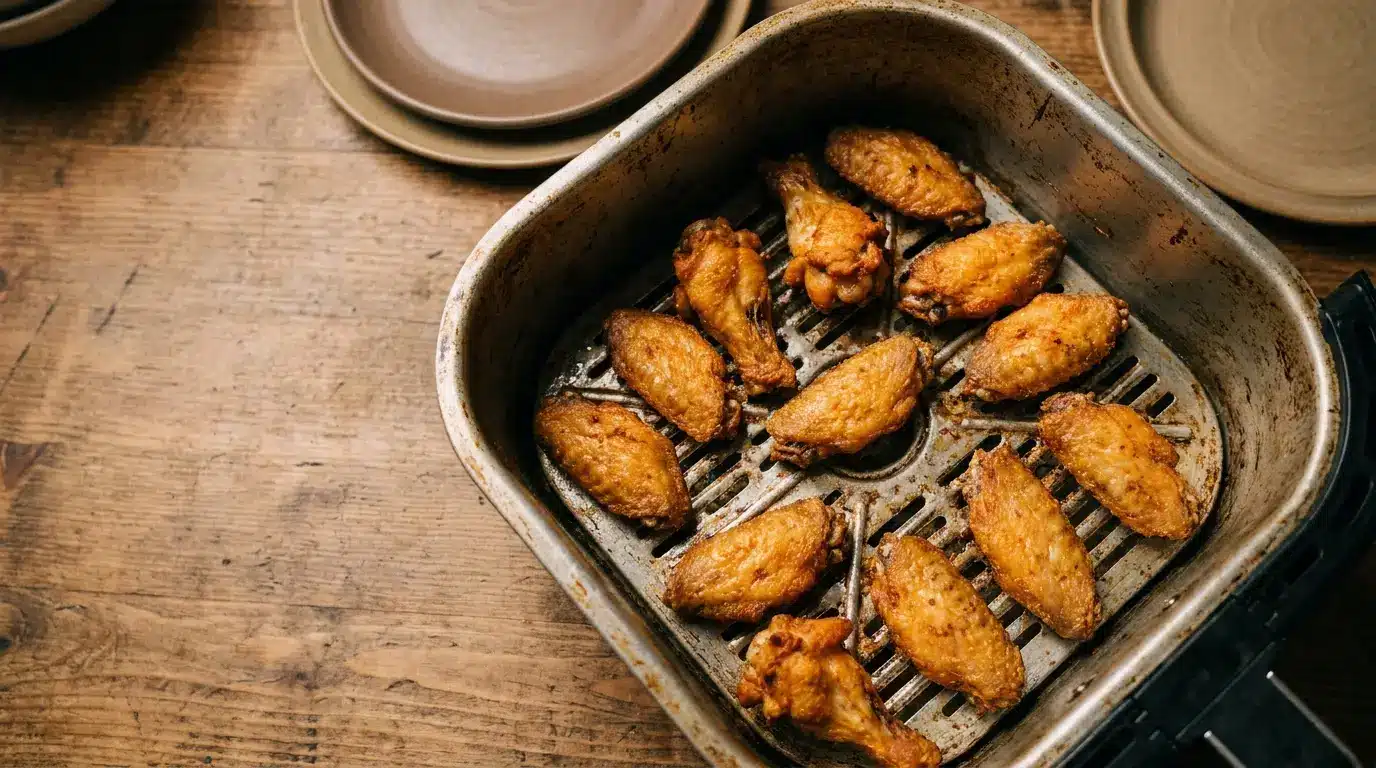
One of the biggest differences between oven cooking and air frying is capacity. A standard oven tray may hold several portions at once, while an air fryer basket has much less space.
Trying to cook the entire oven recipe in one batch can lead to uneven results.
Leave Space Around the Food
Air needs room to circulate. If food is tightly packed, steam gets trapped between pieces and can reduce browning.
For foods such as fries, vegetables, chicken wings, and breaded pieces, arrange them in a single layer when possible.
If the original recipe makes a large amount, divide it into two or more batches.
Keep Pieces Similar in Size
Cutting ingredients into similar-sized pieces helps them finish cooking at roughly the same time.
A tray of potatoes, for example, may contain large and small pieces in the original oven recipe. In the air fryer, smaller pieces can brown much earlier, so try to keep the cuts fairly even.
Shaking the basket or turning the food halfway through can also help different sides cook evenly.
Adjust Oil and Sauces Carefully
Many oven recipes use enough oil to cover a large tray. That same amount may be unnecessary in a smaller air fryer basket.
Use a Light Coating of Oil
Vegetables, potatoes, breaded foods, and some meats can benefit from a thin coating of oil before cooking.
Too much oil can collect in the basket and may make the food feel heavy rather than crisp.
Tossing ingredients lightly before they go into the air fryer is usually enough.
Add Sweet Sauces Later
Sauces containing honey, maple syrup, sugar, or similar ingredients can darken quickly in an air fryer.
If your oven recipe coats the food with a sweet glaze from the beginning, consider adding it during the final few minutes instead.
This gives the food time to cook while reducing the chance of the outside becoming too dark.
Watch the Food Earlier Than You Think
A timer is useful, but it should not be the only way you judge whether a recipe is finished.
Air fryers cook quickly, and the difference between nicely browned and overcooked can sometimes be only a few minutes.
Check During the First Attempt
When converting a recipe for the first time, check the food several minutes before your estimated finish time.
Look at browning, texture, and moisture. If necessary, continue cooking in short intervals.
This approach is especially useful for baked goods, fish, vegetables, and thin cuts of meat.
Use a Thermometer for Meat and Poultry
Appearance alone cannot always tell you whether meat is safely cooked.
For foods such as chicken, ground meat, pork, fish, and reheated leftovers, use a food thermometer when needed.
Common minimum internal temperatures include:
- Poultry: 165°F
- Ground meats: 160°F
- Beef, pork, veal, and lamb steaks, chops, and roasts: 145°F with a short rest
- Fish and shellfish: 145°F
- Leftovers and casseroles: 165°F
Place the thermometer in the thickest part of the food and avoid touching bone.
Think About the Shape of the Original Recipe
The way food is arranged in an oven can affect how well it moves to an air fryer.
A recipe spread across a flat baking sheet usually converts more easily than one cooked in a deep dish.
Shallow Foods Usually Cook More Evenly
Foods arranged in a thin layer allow hot air to reach more of their surface.
This is why roasted vegetables, chicken pieces, fries, and breaded foods often work well.
Deeper foods may need lower heat, more time, or a smaller portion so the middle cooks before the outside becomes too dark.
Use Air-Fryer-Safe Cookware When Needed
Some recipes need a pan, ramekin, or small baking dish rather than the open basket.
Make sure the cookware fits comfortably inside the air fryer and is suitable for the cooking temperature.
Leave some space around the container so hot air can still move through the cooking chamber.
Learn From the First Batch
Your first attempt at converting a favorite recipe may need a small adjustment. That is normal because air fryer models differ in size, heating strength, and basket shape.
Keeping simple notes makes future batches much easier.
Record What Worked
Write down the temperature, total cooking time, batch size, and whether you shook or flipped the food.
For example:
- Broccoli: 375°F for 11 minutes, shaken halfway
- Chicken thighs: 375°F for 20 minutes, turned once
- Potato wedges: 390°F for 18 minutes, two basket shakes
These notes help you create reliable settings for recipes you make often.
Avoid Common Conversion Mistakes
Several problems are easy to prevent:
- Do not use the exact oven temperature automatically.
- Do not assume the full oven cooking time will be needed.
- Do not overcrowd the basket.
- Do not add heavy sauces too early.
- Do not rely only on color when checking meat.
- Do not expect every recipe to convert in the same way.
Small changes usually give better results than trying to force an oven recipe into the air fryer without adjusting anything.
Conclusion
Turning oven recipes into air fryer recipes is mainly about understanding how the cooking environment changes. Lower the temperature slightly, reduce the cooking time, leave enough space around the food, and start checking earlier than you would in an oven.
Recipes that rely on roasting, browning, or crisping are often the easiest to adapt. Large casseroles, liquid-heavy dishes, and wet batters may need more changes or different cookware.