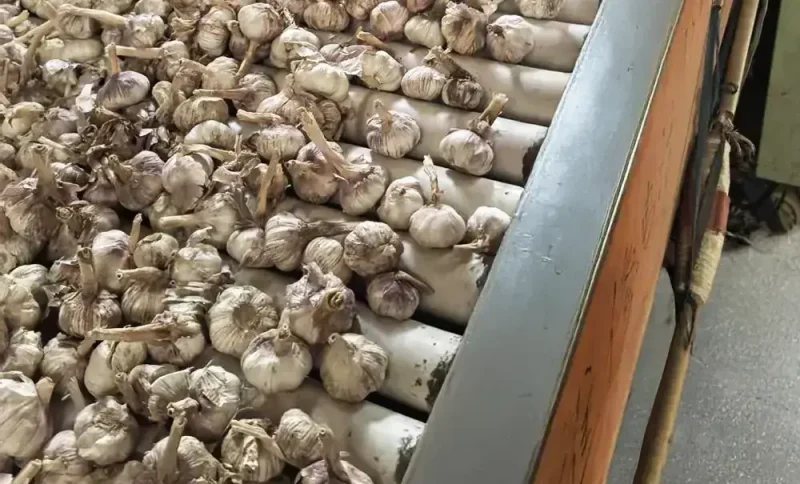
There are several steps taken in order to prepare fresh garlic for overseas markets. Garlic may have to travel great distances before it reaches either a wholesale, food processing facility, or a restaurant distributor. It must be properly sorted, packaged, stored, and transported.
Bulk export then, is a process that entails several steps to ensure that appearance, freshness, and uniformity are maintained in large-scale shipments.
Sorting and Preparing Garlic for Export
After being harvested, garlic has to be prepared for commercial sale. This includes cleaning, drying, sorting, and grading in order to obtain good quality commercial garlic, free of debris and damaged bulbs, thus enabling the production of a uniform shipment. Uniformity can be achieved by removing unsuitable bulbs before packing.
Commercial garlic can be divided into many size categories such as: 4.5 – 5.0 cm, 5.0 – 5.5 cm, 5.5 – 6.0 cm, 6.0 – 6.5 cm, and 6.5 cm and above. This helps to satisfy specific customer requirements.
Choosing the Right Packaging for Bulk Shipments
Packaging has an important role in long-distance transportation. Mesh bags and cartons are commonly used for bulk garlic, with different configurations available depending on the buyer’s requirements. When purchasing from a quality fresh garlic source, packaging specifications can be established before shipment so the product arrives in a format suitable for further distribution.
Why Packaging Weight Matters
A 20 kg mesh bag and a 10 kg carton do not utilize the space within a reefer container in the same manner. The format that the product will take will affect how much you can fit into a reefer container and is therefore an important aspect of export planning.
Temperature Control During Transportation
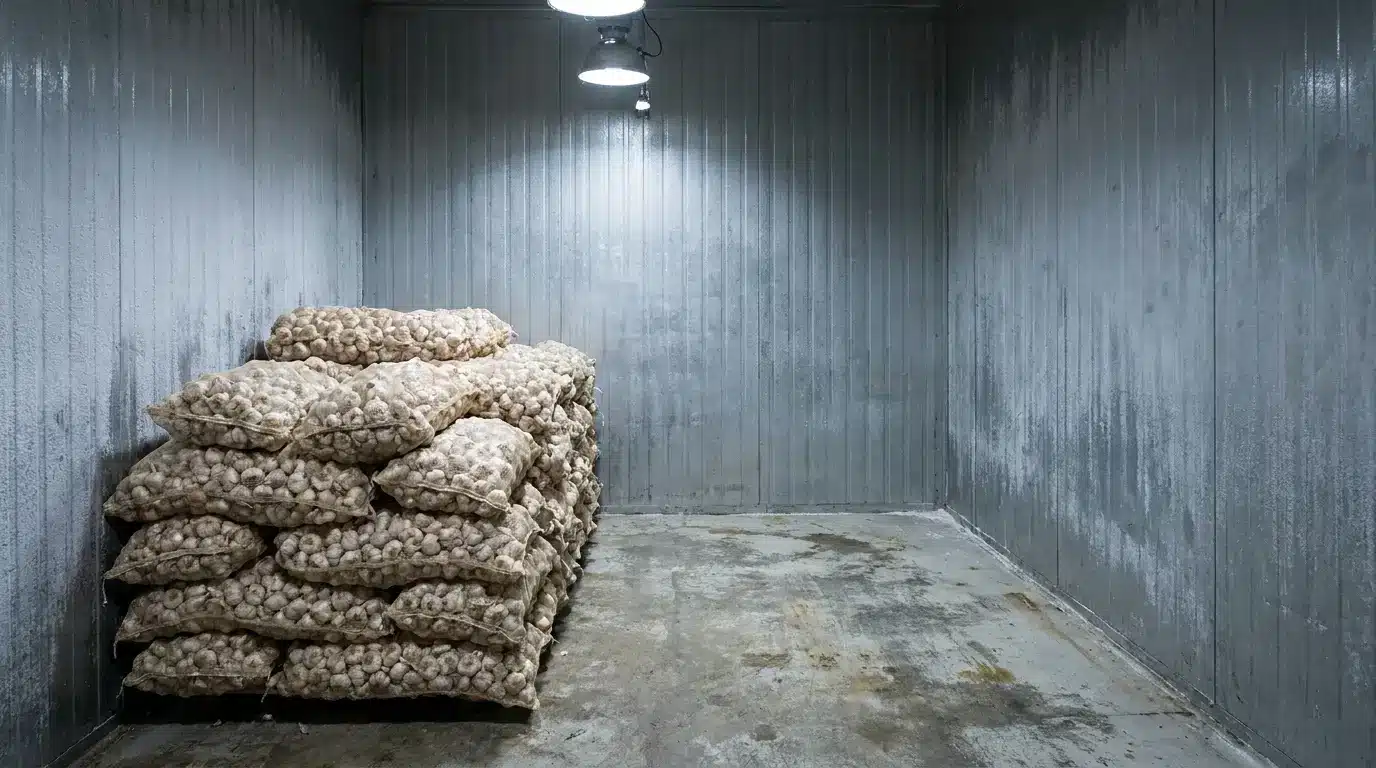
Fresh garlic may spend significant time in storage and transit before reaching its destination. Temperature control is therefore an important consideration for maintaining the condition of the product during long-distance transportation. Garlic that is to be exported is stored and transported in reefer containers, with the supplier listing the temperatures for storage and transportation which is between -3°C and 0°C. This ensures that the product is handled correctly all the way from the packing facility to its destination.
Export Capacity Depends on Container Planning
Bulk shipments need to balance product quantity with packaging configuration and available container space. Efficient loading can make international transportation more practical, particularly when large volumes are being shipped at once.
The following figures provide a useful illustration of typical loading capacities:
|
Logistics Factor |
Typical Figure |
|
40 ft reefer with 20 kg mesh bags |
28–30 MT |
|
40 ft reefer with 10 kg cartons |
24–26 MT |
|
20 ft one-door-open container |
12–14 MT |
|
Storage temperature |
-3°C to 0°C |
|
Transport temperature |
-3°C to 0°C |
|
Example annual Jinxiang production |
800,000 tons |
These numbers show why packaging and container selection should be considered together. A shipment is not planned around product weight alone. The packing format, container type, and temperature requirements all influence how garlic can be moved efficiently across international supply chains.
Preparing Garlic for Different Markets
International buyers may have different expectations concerning bulb size, variety, packaging, and quantity. Some markets may prefer larger bulbs, while others may require particular packaging formats for wholesale or retail distribution.
Matching Specifications Before Shipment
Clear specifications help reduce problems after the cargo has left the origin. Before loading, buyers and exporters can establish the required variety, size range, packaging weight, quantity, and transportation conditions. This creates a more predictable process for both sides.
Quality Depends on More Than Harvesting
A garlic bulb can be grown successfully yet still lose value through poor handling later in the supply chain. Drying, grading, packaging, storage, and transportation each contribute to the condition of the final shipment.
For this reason, buyers looking for quality fresh garlic should consider how the product is handled after harvesting rather than focusing only on its appearance at the time of purchase.
The Final Step Before International Delivery
Bulk garlic export works best when agricultural preparation and logistics are treated as connected processes. Careful grading creates consistency, appropriate packaging protects the product, and refrigerated transportation helps maintain suitable conditions over long distances.
From the first sorting stage to the final container load, each decision contributes to the shipment’s overall quality. When these steps are properly coordinated, fresh garlic can travel from its production region to international markets in a form that is ready for wholesalers, distributors, processors, and other commercial buyers.
Sorting and Preparing Garlic for Export
After being harvested, garlic has to be prepared for commercial sale. This includes cleaning, drying, sorting, and grading in order to obtain good quality commercial garlic, free of debris and damaged bulbs, thus enabling the production of a uniform shipment. Uniformity can be achieved by removing unsuitable bulbs before packing.
Size Grading Allows for Greater Choice and Control
Commercial garlic can be divided into many size categories such as: 4.5 – 5.0 cm, 5.0 – 5.5 cm, 5.5 – 6.0 cm, 6.0 – 6.5 cm, and 6.5 cm and above. This helps to satisfy specific customer requirements.
Choosing the Right Packaging for Bulk Shipments
Mesh bags and cartons are the most common packaging materials used for bulk shipments of garlic. Various configurations can be chosen in accordance with the requirements of the buyer. If one is considering buying garlic from a reliable source of fresh produce, the specifications of the packing materials can be decided before hand in order to get the product in a packaging material suited to one’s own needs.
Why Packaging Weight Matters
A 20 kg mesh bag and a 10 kg carton do not utilize the space within a reefer container in the same manner. The format that the product will take will affect how much you can fit into a reefer container and is therefore an important aspect of export planning.
Temperature Control During Transportation
Fresh garlic may be stored and transported for a long time before reaching its destination, making temperature control an important factor.
Garlic that is to be exported is stored and transported in reefer containers, with the supplier listing the temperatures for storage and transportation which is between -3°C and 0°C. This ensures that the product is handled correctly all the way from the packing facility to its destination.
Export Capacity Depends on Container Planning
A product that is going to be shipped in bulk requires a careful balancing act between product quantity, packing configuration, and container utilization in order to maximize the amount that can be shipped.
The following figures can serve as a helpful example of how the quantity that can fit into a reefer container:
The above example illustrates why the packing materials should be chosen according to the container size. It is obvious that the product weight cannot be the sole deciding factor when considering the quantity that can be shipped. The packing configuration and container size must also be taken into account when planning a shipment of fresh garlic.
Preparing Garlic for Different Markets
International buyers may have various requirements regarding size, variety, packing, and quantity. Some may prefer larger sizes of garlic, while others may require certain packing configurations for wholesale or retail.
Matching Specifications Before Shipment
By choosing the required variety and size, and determining the desired packing weight, quantity, and transportation requirements, the complications after the shipment has left the country of origin can be avoided. This allows for a much smoother process for both the exporter and the importer as certain standards are set before hand, eliminating many potential problems.
Quality Depends on More Than Harvesting
Although a good harvest is necessary for good quality fresh garlic, the quality can be compromised after harvesting if the correct procedures are not followed. Drying, grading, packing, storage, and transportation all have an effect on the quality of the final export shipment.
For this reason buyers of fresh garlic can no longer rely solely on the visual inspection of produce in order to judge its quality. Instead one should consider the post-harvesting practices of the seller.
The Final Step Before International Delivery
Bulk export of garlic requires farmers and suppliers to understand that agricultural production and commercial export are inter-related processes. Good post-harvesting practices such as grading will lead to a uniform product, while the use of suitable packing materials and reefer transport will ensure that the shipment arrives at its destination in an appropriate temperature and in good condition. From preparation to packaging every step has an effect on the final result. Proper bulk export of garlic makes it possible to deliver high quality fresh garlic to international buyers who deal in wholesale, distribution, or food processing.