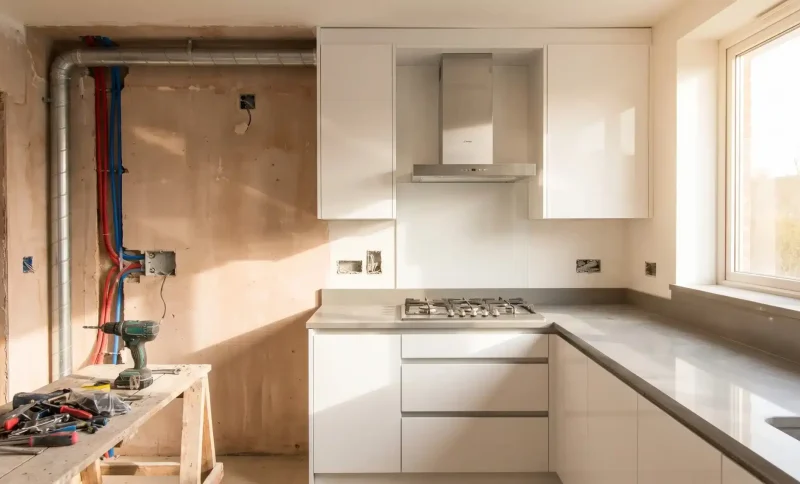
Most kitchen renovations start the same way. You pick your units, choose a worktop, agonise over whether to go for quartz or oak, and then hand everything over to a fitter. It’s only once the kitchen is in that you realise the extractor fan is too quiet, there’s nowhere to plug in your stand mixer, and the light above the hob casts a shadow right where you’re trying to chop.
These aren’t cosmetic issues. They’re planning issues, and they’re incredibly common. Let’s get into it and find out why they keep happening, and how to avoid them.
Extraction Is an Afterthought for Too Many People
A good extractor isn’t just about smoke. When you’re reducing a stock, frying fish, or roasting a joint, the steam and smell that builds up in a kitchen is significant. If your extraction isn’t up to the job, it ends up in your walls, your curtains, and eventually your lungs. The rule most people don’t know: your extractor should turn the air over in the room at least ten times per hour. That means you need to check the cubic metre capacity of your kitchen and match the extractor’s output accordingly.
Ducted extraction, where air is pushed out through an external wall or roof, will always perform better than a recirculating model. If you’re doing a full renovation, this is the time to add ducting. Retrofitting it later means cutting into cabinets or walls that have already been fitted and finished. Worth planning early.
Where Your Sockets Are Will Either Make or Break Your Kitchen
Builders tend to put sockets where they’re easy to wire, not where you actually need them. Think about your workflow before sign-off. Where do you prep? Where does your kettle live? Do you use a food processor, a hand blender, a stand mixer? All of these need a socket within reach, and ideally not the same one you’re using for the toaster.
A useful approach is to walk through a full cook in your head before the kitchen goes in. Start from getting ingredients out of the fridge, through prep, to cooking, to plating. Every step where you’d reach for a plug is a step where you need a socket. Most kitchens are under-socketed by at least two or three points. Add more than you think you need while the walls are still accessible.
Lighting Zones Get Ignored Until It’s Too Late
Overhead lighting alone won’t cut it in a working kitchen. A single ceiling fitting will throw shadows across your worktop every time you stand at it. You need task lighting under cabinets for prep areas, and something warmer and dimmable for when you’re eating or winding down after cooking.
The zone that gets forgotten most often is above the hob. It needs to be bright enough to see what’s happening in a pan, but it also needs to be heat-resistant and easy to clean. Integrated lighting in the extractor hood solves both problems neatly, but it has to be specified before the kitchen goes in.
Hot Water and Heating: Don’t Forget the Boiler
Kitchens often hide the boiler inside a tall unit or a cupboard, and that works fine until the boiler needs servicing or replacing. If a new unit is going in front of it, make sure there’s proper access built into the design. Engineers need to be able to reach the flue, the controls, and the pipework without dismantling your cabinetry.
It’s also worth thinking about where your hot water supply runs while the walls are open. If your boiler is old and you’re already spending money on the kitchen, it’s worth looking at whether a replacement makes sense at the same time. iHeat offers next-day boiler installation with fixed pricing, which is useful to know if the project uncovers an ageing unit that needs to come out sooner than expected.
The Details That Fitters Won’t Always Flag
There are a few more things that regularly catch people out during kitchen renovations:
- Bin placement: Where your bin lives affects how often you have to walk across the kitchen with a load of peelings. Build it into the design early, not as a last-minute afterthought.
- Fridge clearance: American-style fridge-freezers need more door-swing room than most plans account for. Measure twice.
- Plinth height: If you’re taller than average, raising the worktop height by even 50mm can make a significant difference to your back during long cooking sessions.
- Noise from appliances: Dishwashers and washing machines in open-plan kitchens can be surprisingly disruptive. Look at the decibel rating before you buy, not after.
What It All Comes Down To
The kitchens that work well long-term are the ones where the owner thought like a cook before the fitters arrived. That means thinking about workflow, not just aesthetics. Where you stand, what you plug in, how you ventilate, and whether you can actually see what you’re doing all matter more than the finish on your cabinet doors.
A renovation is a rare chance to get all of this right from scratch. Take your time at the planning stage, and you’ll spend far less time working around problems later.