There is a particular kind of kitchen optimism that arrives five minutes before a bad idea.
You have half a lemon, a lonely sweet potato and a jar of something purchased during a brief but enthusiastic interest in Korean cooking. Dinner needs to happen. Going to the store feels unreasonable. Surely, you think, these ingredients can become a meal.
Sometimes they do. Sometimes they become a lesson.
Working with an AI image generator feels surprisingly similar. You begin with a collection of ideas, mix them together and wait to see whether the result resembles the picture in your head. The machine may produce something beautiful. It may also give your dinner table seven chairs, three forks floating in mid-air and a chocolate cake decorated with what appear to be tiny potatoes.
This is why the most useful way for food lovers to understand generative AI is not as magic. It is as a new kind of kitchen: fast, experimental and occasionally chaotic.
The prompt is the recipe. The details are the ingredients. Your judgment decides whether the result is worth serving.
A vague recipe produces a vague dinner
Imagine receiving these cooking instructions: “Make something delicious with vegetables. It should look fancy but also casual.”
That is not a recipe. It is a request for trouble.
A vague image prompt causes the same problem. Ask for “a beautiful photo of pasta,” and the generator must make every important decision on your behalf. What type of pasta? Which sauce? Is it served in a rustic Italian kitchen, a modern restaurant or beside somebody’s laptop at lunchtime? Should the photograph feel warm and homemade or precise and editorial?
The result may be attractive, but it will probably look like a generic stock image. There will be a beige napkin, a suspiciously perfect basil leaf and a wooden table that has apparently appeared in every imaginary restaurant on the internet.
A better prompt works like a useful recipe. It gives structure while leaving room for taste:
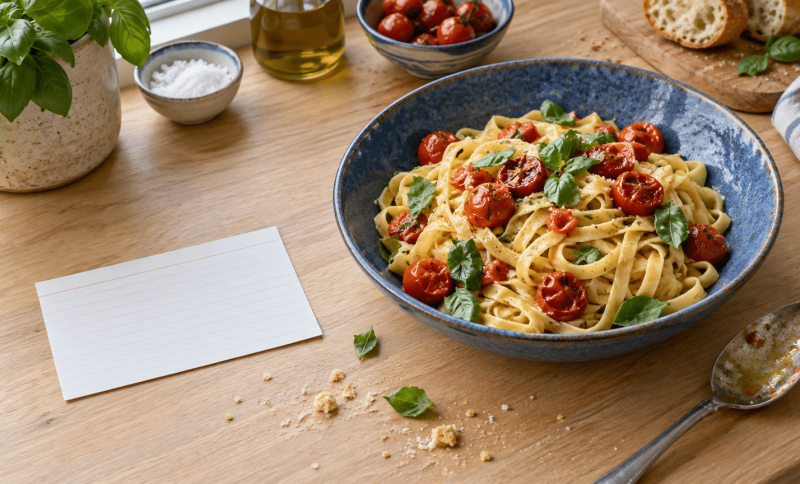
“Fresh tagliatelle with roasted cherry tomatoes and torn basil in a shallow blue ceramic bowl, photographed near a kitchen window on a rainy afternoon, natural light, a little messy, no restaurant styling.”
Now the machine has something to work with. More importantly, the image has a point of view.
Food creators already understand this instinctively. A recipe is never just a list of ingredients. It also contains temperature, texture, timing and mood. “Cook the onions” is different from “cook the onions slowly until soft and golden at the edges.” The second instruction tells you what success looks like.
Good prompts do the same.
The first result is only the first pancake
Almost every family has a rule about the first pancake. It sticks, tears or comes out shaped like a country nobody can identify. You eat it anyway, adjust the heat and continue.
AI images deserve the same patience.
People often enter one prompt, dislike the output and conclude that the technology is useless. That is like abandoning a cake because the flour has not turned into dessert after ten seconds of stirring. The first image is information. It shows which parts of the instruction the system understood and which parts need attention.
Perhaps the food looks right but the lighting is too cold. Keep the dish and change the light. Perhaps the composition is lovely but the portion resembles something prepared for a giant. Adjust the scale. Perhaps the table looks so perfect that no human being would dare sit at it. Add crumbs, a folded tea towel and a spoon left slightly crooked.
Small changes are easier to control than complete rewrites. If every ingredient in the prompt changes at once, it becomes impossible to know what improved the result.
This part should feel familiar to anyone who cooks without following instructions word for word. Taste, correct, taste again. More salt. Less heat. A squeeze of lemon. The creative process was iterative long before anybody gave it a technological name.
Food ideas no kitchen budget could survive

The most exciting use of AI for food creators may not be generating realistic pictures of ordinary dinners. We already have cameras for that.
Its real strength is visualising ideas that would be expensive, wasteful or physically impossible to stage.
A baker can explore five versions of a wedding cake before making a single flower from sugar. A party planner can compare table settings in different colours without buying six sets of plates. A food stylist can test whether dark stone, warm wood or bright linen best suits a new recipe series. A blogger planning a Halloween feature can picture a gothic dessert table complete with black candles and dramatic shadows before dragging half a furniture store into the dining room.
Then there are the wonderfully unnecessary experiments.
What would a bakery on Mars sell? How might a brunch inspired by a 1980s arcade look? Could a pavlova be designed like a coral reef? What would tiny woodland creatures serve at a formal Sunday lunch?
Not every idea needs to become an actual recipe. Some are simply fun, and food culture has always made room for imagination. Gingerbread houses are not efficient housing. Birthday cakes do not require miniature castles. We make them because the table is one of the places where adults are still allowed to play.
Every interest is becoming its own little digital kitchen
The AI market is moving away from a handful of general tools and towards generators designed for specific communities. There are tools for interior concepts, fashion sketches, game characters, tattoos, children’s illustrations and professional headshots. Food creators can find systems for menu photography, recipe development and product mock-ups.
The level of specialisation can become wonderfully unexpected. Alongside generators for visualising cakes or arranging imaginary dinner tables, there are highly specific adult platforms such as an AI futanari generator, built for a fantasy niche that sits a very long way from the average batch of banana muffins.
The point is not that a food blogger needs every specialist tool. Clearly, nobody requires that particular generator to decide how much cinnamon belongs in an apple crumble. What matters is the direction of travel. People no longer want one enormous machine that produces an acceptable version of everything. They want tools that understand the conventions, vocabulary and expectations of a particular interest.
Food technology will follow the same path. A general image model may know what a croissant looks like. A specialised food tool should understand lamination, crumb structure, realistic portions and the annoying fact that melted cheese does not behave like yellow fabric.
That difference matters when an image is being used for more than entertainment.
A delicious picture can still tell a lie
Food blogging depends on trust.
If a reader follows a recipe, the finished dish should at least belong to the same family as the one shown in the photograph. It may not be identical—home ovens have personalities, and some of them are hostile—but the image should represent something that can genuinely be made.
AI complicates that relationship.
A generated cake does not need structural support. Its strawberries can balance at impossible angles. Its frosting never becomes too warm. A bowl of soup can contain herbs that do not exist and noodles that quietly disappear beneath the surface without ever returning.
Such images are harmless when presented as fantasy or early-stage inspiration. Problems begin when they are used as proof of a recipe that nobody actually cooked.
Readers deserve to know the difference. If an image is AI-generated, say so. If it is a concept for a future project, describe it that way. If a generated picture inspired a real dish, show the real result as well—even if the icing leans slightly to the left.
Especially if the icing leans slightly to the left.
The imperfections reassure people that food has passed through an actual kitchen. A scorched edge, a thumbprint in pastry or a sauce that refuses to sit neatly can be more appetising than synthetic perfection because it looks possible.
The camera is not ready for retirement
AI will not make food photography unnecessary. If anything, it may remind us why genuine food photographs are satisfying.
A camera records the evidence of cooking: steam rising from a pot, butter shining on toast, crumbs left after the first slice and the slight collapse of a cake as it cools. Those details are not merely visual. They tell us that the food existed, that somebody made it and that somebody could eat it.
Generated images are excellent for planning a shoot. A creator can test colour palettes, angles and props before cooking day. They can use a synthetic image as a rough storyboard: bowl here, spoon there, light from the left. That preparation may reduce waste and save time.
Once the real dish arrives, however, it deserves its own portrait.
The best food content may combine both approaches. Use AI for the impossible, the speculative and the early draft. Use photography for the recipe readers are expected to cook. The boundary does not need to be defensive. It simply needs to be clear.
Taste remains stubbornly human
An image generator can produce 100 variations of a cupcake in the time it takes to preheat an oven. It cannot tell you which one feels right for your audience.
That decision comes from taste—not taste in the literal sense, although AI remains particularly poor at checking whether your soup needs salt. It comes from knowing when an image is charming rather than childish, dramatic rather than gloomy, abundant rather than cluttered.
Food creators build that judgment through years of looking, cooking and making mistakes. They remember the recipe that sounded awful but worked. They know when a supposedly easy trend is going to leave readers washing six bowls. They can sense the difference between a photograph that creates hunger and one that merely shines.
No prompt can replace that experience.
This may be the most comforting thing about generative tools. As they become faster and more capable, the human contribution does not disappear. It moves. Less time may be spent producing the first rough concept, while more attention goes to choosing, correcting and adding personality.
The machine brings possibilities to the counter. The creator decides what belongs on the plate.
And if the first attempt emerges with six spoons, levitating parsley and a cake made of potatoes? Consider it the first pancake. Have a laugh, adjust the recipe and try again.