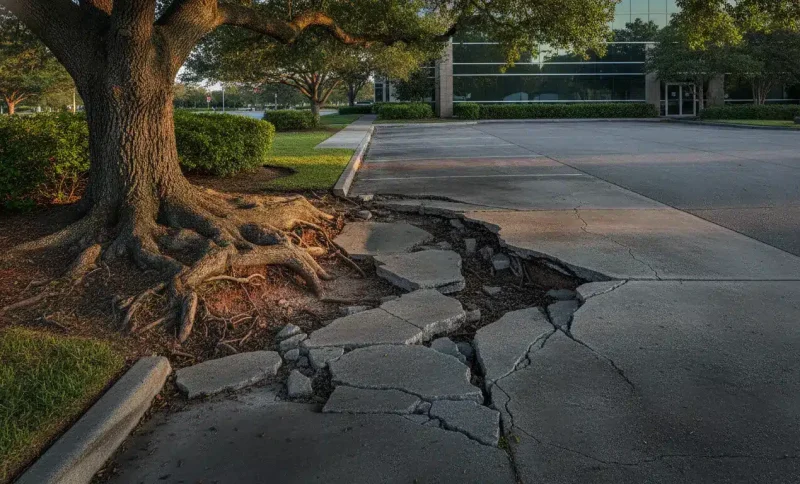
Commercial property owners spend considerable time thinking about building systems, tenant improvements, lease terms, and capital expenditure schedules. The relationship between the landscaping surrounding a property and the concrete infrastructure it sits alongside rarely receives the same analytical attention, despite the fact that decisions in each category directly affect the performance, longevity, and cost of the other.
This gap in how these two elements are managed independently rather than as an integrated system creates predictable problems that appear expensive and sudden but are actually the cumulative result of years of decisions that didn’t account for how landscaping and concrete interact on a commercial property.
How Tree Root Systems Affect Commercial Concrete
The most significant and most consistently underestimated interaction between landscaping and commercial concrete involves tree root systems and the pavements, walkways, and structural elements they grow beneath. Tree roots follow moisture and nutrient gradients through the soil, and the subbase conditions beneath concrete pavement create a specific environment that root systems exploit in ways that cause progressive concrete damage.
Concrete pavement creates a microclimate beneath it: protected from surface evaporation, consistently moistened by water migrating through cracks and joints, and warmer than surrounding unprotected soil. These conditions attract root growth from nearby trees that leads to root systems establishing extensively beneath pavement in ways that weren’t apparent when the trees were young and the pavement was new.
As root systems grow beneath concrete, they exert upward pressure on the slab above them that eventually produces heaving, cracking, and surface displacement that creates both safety hazards and drainage problems. The damage follows a trajectory from minor cracking that’s an aesthetic concern to significant displacement that creates trip hazards and ADA compliance issues to structural compromise that requires full reconstruction of the affected pavement section.
Irrigation and Its Effect on Concrete Subbase Stability
Commercial landscaping irrigation systems deliver water to planting areas on schedules designed for plant health without necessarily considering how irrigation water movement affects the soil beneath adjacent concrete pavement. Water applied near the edges of pavement structures migrates laterally through the soil, reaching subbase material beneath concrete and affecting its stability over time.
Subbase material beneath commercial concrete pavement is engineered to provide stable, well-drained support for the slab above it. Consistent additional moisture from irrigation changes the moisture content of this subbase material in ways that weren’t accounted for in the original pavement design, potentially reducing its load-bearing capacity and creating differential settlement as some sections receive more irrigation moisture than others.
The result is concrete pavement that settles unevenly, producing surface drainage patterns that direct water toward building entrances rather than away, joints that separate as sections move independently, and surface cracking that follows the differential settlement pattern rather than the expansion joint pattern the original design intended.
Working with qualified landscaping services on irrigation design specifically addresses placement of irrigation heads relative to pavement edges, selection of irrigation emitter types that minimize water spread beyond target planting areas, and scheduling that balances plant health with minimizing pavement subbase moisture exposure.
Drainage Design as a Shared Responsibility
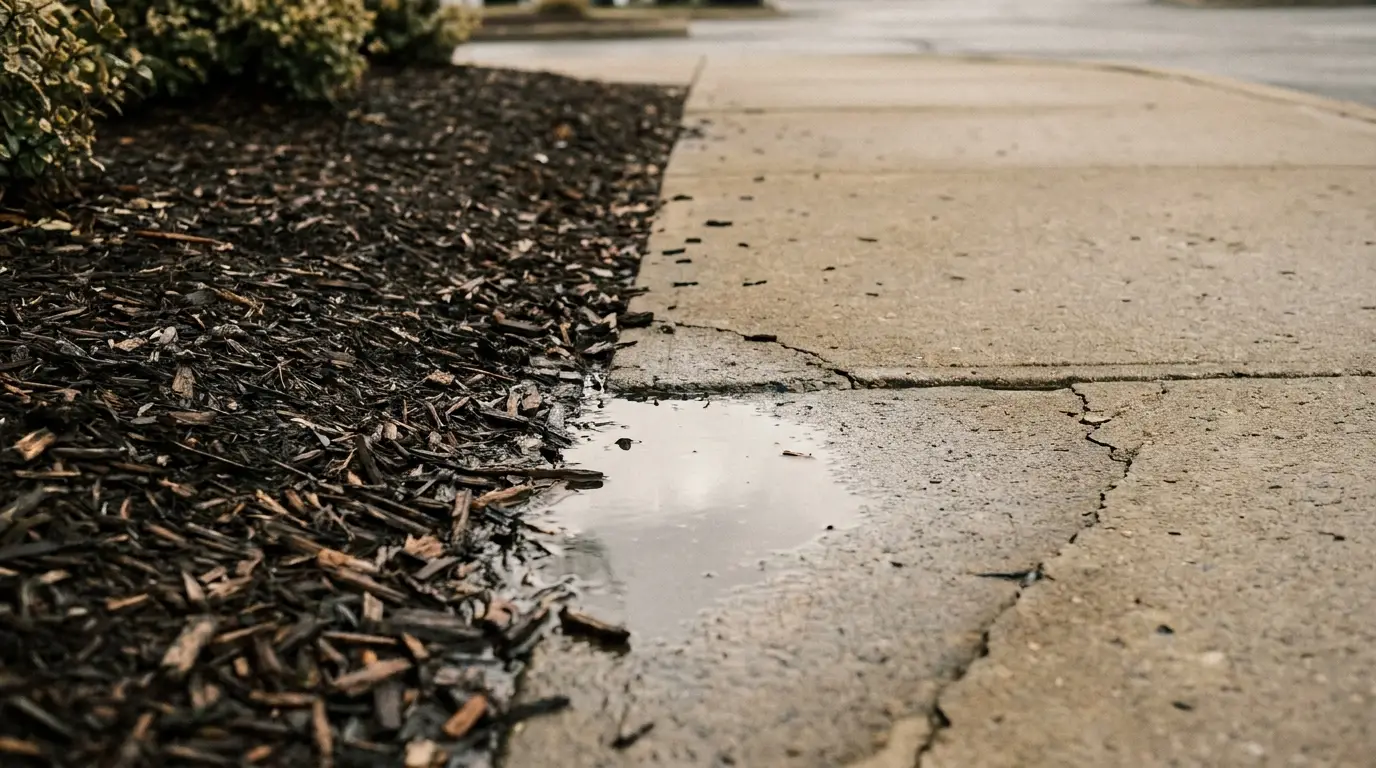
Surface water drainage on a commercial property is managed by both landscape grading and concrete pavement design working together. Landscape areas are graded to direct runoff toward collection points. Concrete pavement is sloped to move water to drain inlets. These two drainage systems are designed to hand off water from one to the other at their boundaries in ways that require coordination to function correctly.
When landscaping modifications are made without considering how they affect the drainage relationship with adjacent concrete, the result can redirect water toward pavement rather than away from it. Raised planting beds installed along pavement edges direct water onto the pavement rather than away from the building. Landscape grading changes that create low points adjacent to concrete concentrate water in locations where it previously drained away.
Concrete that receives consistent additional water from redirected landscape drainage develops accelerated freeze-thaw damage in cold climates, sustained moisture exposure that affects joint sealant longevity, and subbase saturation that leads to the settlement issues discussed above. Drainage coordination between landscape and concrete professionals at the design stage prevents these interactions. Remediation after the problems develop is significantly more expensive than prevention would have been.
Concrete Condition and What It Means for Landscape Planning
The relationship between landscaping and concrete runs in both directions. Just as landscaping decisions affect concrete performance, concrete condition affects landscaping planning in ways that property owners should understand before committing to landscape investments.
Concrete pavement or structural elements that are approaching end of service life represent capital expenditure that will require excavation and reconstruction within a defined timeframe. Landscape investments installed adjacent to or over these elements face disruption when that reconstruction happens. Trees planted near pavement sections scheduled for reconstruction within five years face root disturbance at a critical growth stage. Irrigation systems installed beneath pavement areas that will need to be removed for concrete repair require reinstallation as part of the concrete project.
Understanding the condition and projected service life of commercial concrete components before making landscaping investments allows property owners to sequence their capital expenditures in ways that avoid this disruption. Working with a commercial concrete contractor to assess pavement and structural concrete condition produces a timeline for required work that landscape planning can be built around rather than planned in ignorance of.
Plant Selection and Its Long-Term Concrete Implications
Not all plants pose equal risk to adjacent commercial concrete, and selecting plant species with this consideration in mind from the beginning of a landscaping project is considerably more effective than addressing the damage caused by inappropriate species selection years later.
Trees with aggressive, shallow root systems planted near commercial concrete pavement create predictable damage timelines. Species known for shallow lateral root growth are specifically problematic near pavement edges regardless of initial planting distance, because root systems at maturity extend well beyond what the young tree’s canopy would suggest. Choosing species with deeper, less aggressive root systems for locations near commercial concrete, or using root barrier systems where preferred species are used near pavement, addresses this issue proactively.
Shrubs and ground covers planted near concrete expansion joints create a different problem: root systems that exploit joint openings to establish beneath concrete, accelerating joint deterioration and creating pathways for water infiltration into the subbase. Plant species selection and placement that accounts for joint locations in adjacent concrete pavement prevents this specific damage mechanism.
The Management Approach That Prevents Most Problems
The most effective approach to managing the landscaping-concrete relationship on commercial properties involves both disciplines in the planning and maintenance conversation rather than managing each independently on separate schedules without reference to the other.
Landscape maintenance schedules that include assessment of root growth relative to adjacent pavement catch developing root intrusion before it produces significant damage. Concrete maintenance programs that include assessment of pavement condition near landscaping catch early-stage root-related damage before it requires expensive remediation. The two maintenance programs sharing information about what each is finding produces a combined picture that neither generates independently.
For property owners currently managing landscaping and concrete as separate maintenance programs without coordination between them, creating a structured conversation between the professionals managing each is the most practical starting point for addressing the gaps that independent management consistently produces.