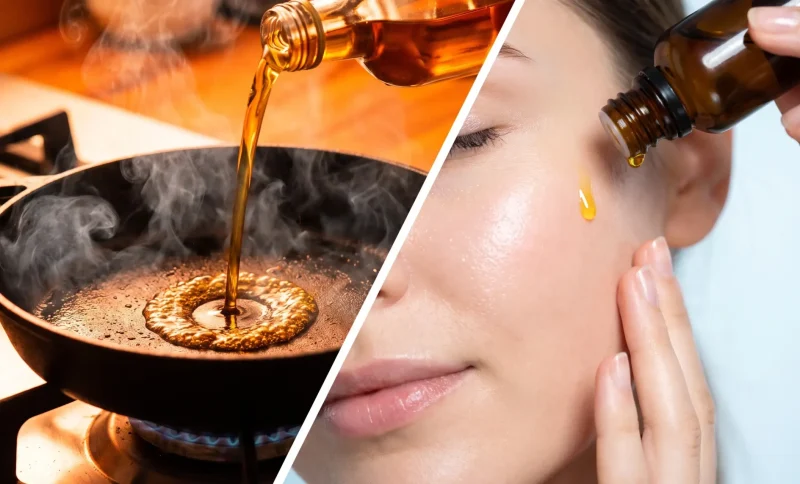
Sunflower oil has become a punchline. Grapeseed, safflower, soybean too. Read about food for any length of time and you’ll have watched all of them slide out of the healthy column into the suspicious one.
Then you turn over a $68 bottle of facial oil and there they are again, listed like luxury goods.
Both can be true at once. Sorting out why comes down to a single fatty acid, a single variable, and a distinction that gets skipped almost everywhere. If you cook, you already have most of the background knowledge. You just haven’t applied it to your face yet.
Same Molecule, Very Different Job
Linoleic acid is what the whole argument circles around. An omega-6 polyunsaturated fat, and the dominant one in sunflower, safflower, grapeseed, corn and soybean oils.
Eat it and your body sends it down a metabolic pathway. The nutrition argument lives there – how much of it people are getting, how that stacks up against omega-3 intake, and what heat does to those fragile double bonds along the way. Fair questions, all of them.
When you apply it to your skin, none of that pathway is involved. Linoleic acid is a direct structural precursor to ceramide 1, one of the lipids that holds the outermost layer of your skin together. Your skin barrier is essentially a brick wall – cells as bricks, lipids as mortar – and linoleic acid is part of the mortar recipe.
This is why essential fatty acid deficiency shows up on the skin before it shows up anywhere obvious. Scaly, rough, water-losing skin is a classic sign. Your face is telling you something your bloodwork hasn’t gotten around to yet.
So the same compound is a topic of dietary debate and a structural building material, depending on which side of your skin it’s on. Not a contradiction. Two separate questions that happen to share a molecule.
Heat Is the Entire Argument
Here’s the variable almost every discussion skips.
The strong version of the anti-seed-oil case is really about repeated high-heat cooking. Those same double bonds that keep the oil pourable at room temp are what make it oxidize so easily. Take a bottle of sunflower oil to 400°F, hold it there, reuse it, and you generate aldehydes and other oxidation byproducts that weren’t in the bottle when you opened it.
Now consider what happens to a facial oil. You warm four drops between your fingertips. Room temperature, maybe body temperature at most. There is no frying involved, no smoke point to exceed, no reuse cycle.
Whatever you believe about seed oils in a deep fryer, none of that mechanism transfers to a bottle sitting on your bathroom counter.
Quick tip: the one oxidation risk that does carry over is storage. Light and heat degrade polyunsaturated oils in both contexts. If your facial oil came in dark or opaque glass, that’s a formulation decision, not packaging aesthetics – and it’s the same reason good olive oil never comes in a clear bottle.
The Oleic-Linoleic Split
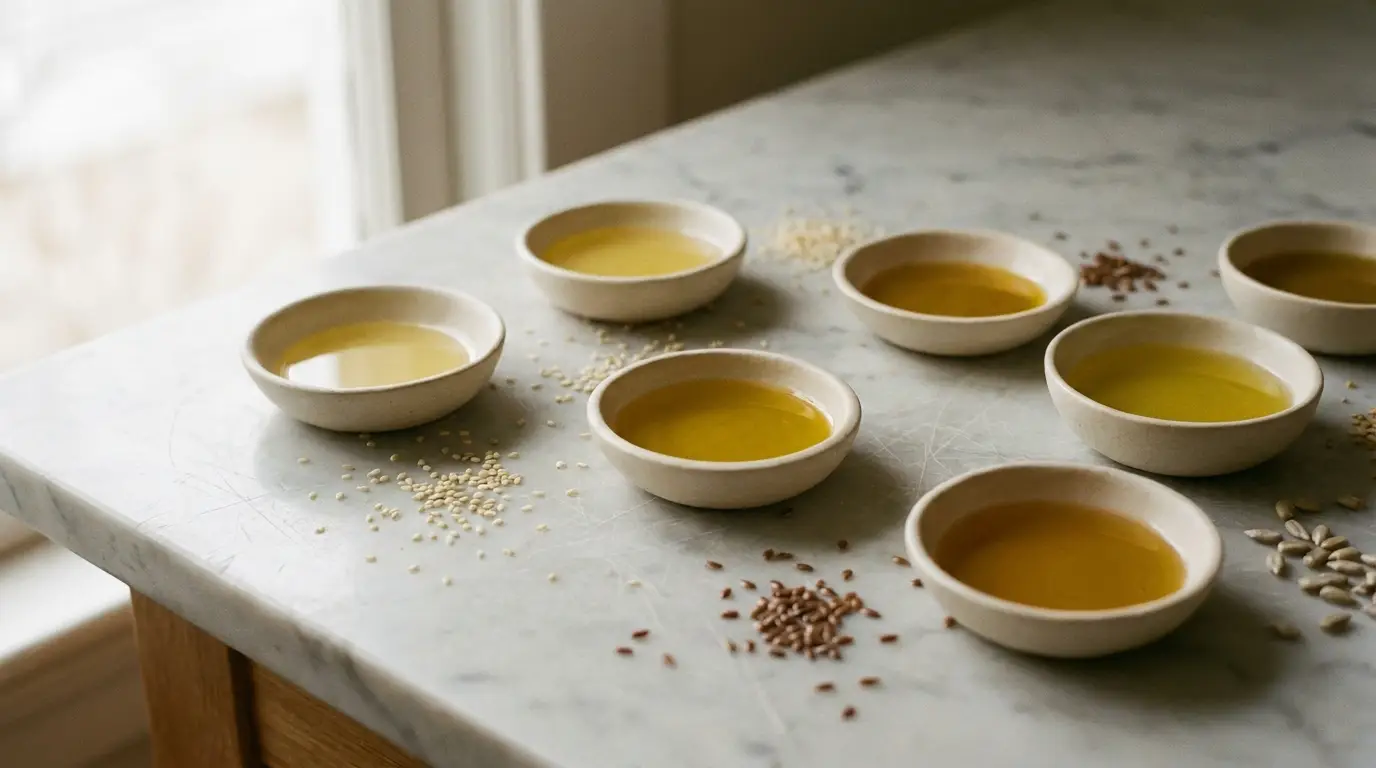
This is where kitchen instincts actively mislead people.
Olive oil is the good guy on your plate. Avocado oil is the upgrade. Oleic acid, a monounsaturated fat, dominates both. Their food reputations are excellent.
On skin, high-oleic oils behave differently. In research settings oleic acid gets used as a penetration enhancer. It loosens up how lipids are organized in the stratum corneum so other things can slip through. Useful in a lab. Less handy when your barrier is already dry or cranky or compromised. One study put olive oil against sunflower seed oil on infant skin, and the olive oil side came out with worse barrier function.
Which flips the whole hierarchy. The oil you’d reach for in a pan is not automatically the oil you’d want on a dry winter face.
There’s an interesting wrinkle here involving acne, too. Research going back to the 1980s found that sebum from acne-prone skin tends to contain proportionally less linoleic acid. The association has held up reasonably well, and it’s part of why “oily skin should avoid oils” turned out to be too blunt a rule.
Well-built facial oils tend to blend across both categories rather than pick a side. Something like facial oil for younger looking skin from Prima layers prickly pear and rosehip (both linoleic-forward) with moringa and marula (oleic-forward) and chia seed oil, which is the richest botanical source of omega-3 ALA. Prima’s own independent clinical study, run on 30 women over eight weeks, reported a 33% improvement in skin hydration and a 16% improvement in visible firmness. Small sample, company-commissioned – read it as directional rather than definitive. But the formulation logic is the interesting part: blend the profiles, don’t bet on one fatty acid.
Jojoba Isn’t an Oil
Something to know when you’re squinting at an ingredient list.
It’s a liquid wax ester. Not a triglyceride, which is what every oil in your pantry is. Closer in structure to human sebum than to olive oil, and that explains a lot – the light feel despite the name, the shelf stability that polyunsaturated oils can’t match, the way it keeps turning up at the top of ingredient lists.
Nobody cooks with it. It’s a category of its own.
One cheek. That’s the trick for testing a new oil – use it on one side of your face for a week and leave the other alone. Do your whole face and you’ll never untangle whether the difference came from the product, the weather, or finally getting some sleep.
What Doesn’t Transfer
A few things the crossover doesn’t cover.
The bottle in your kitchen is not cosmetic-grade. Food oils aren’t formulated or tested for facial application, and an unrefined cooking oil can carry proteins and particulates that a cosmetic-grade version has removed.
Coconut oil is the most common casualty of this confusion. Excellent for cooking, highly comedogenic for a lot of people. Being edible tells you nothing about whether it clogs pores.
And nothing you apply topically substitutes for what you eat. Dietary fats affect skin through an entirely different route, on a much slower timeline.
The Useful Takeaway
The seed oil conversation collapsed two separate questions into one. Eating a lot of a heat-degraded omega-6 oil and applying a small quantity of an unheated one to your face have almost nothing in common beyond the name on the label.
If you already read oil labels for your cooking – checking for cold-pressed, checking the bottle color, checking the date – you’ve built a skill that transfers directly. Same scrutiny, different shelf.
Just don’t assume the ranking carries over with it.