Ask five different safari operators when the “best” time to visit Africa is, and you’ll likely get five different answers. That’s because “safari season” isn’t a single window on a calendar — it shifts depending on which country you’re visiting, what you want to see, and how much rain a particular region gets in a given year.
Understanding the actual mechanics behind these seasons makes it much easier to plan a trip that matches your priorities, whether that’s watching wildlife concentrate around water sources or catching newborn animals in green, quiet landscapes.
Why There’s No Single Safari Season
Africa spans both hemispheres, which means weather patterns don’t move in sync across the continent. While Kenya and Tanzania are drying out in July, parts of Zambia and Botswana are also dry, but Namibia’s desert regions behave on an entirely different rhythm tied to sparse, unpredictable rainfall.
Rather than thinking of “African safari season” as one thing, it helps to break it down by region and by what’s actually happening on the ground — water levels, vegetation growth, and animal movement.
East Africa’s Dry Season Draws the Crowds
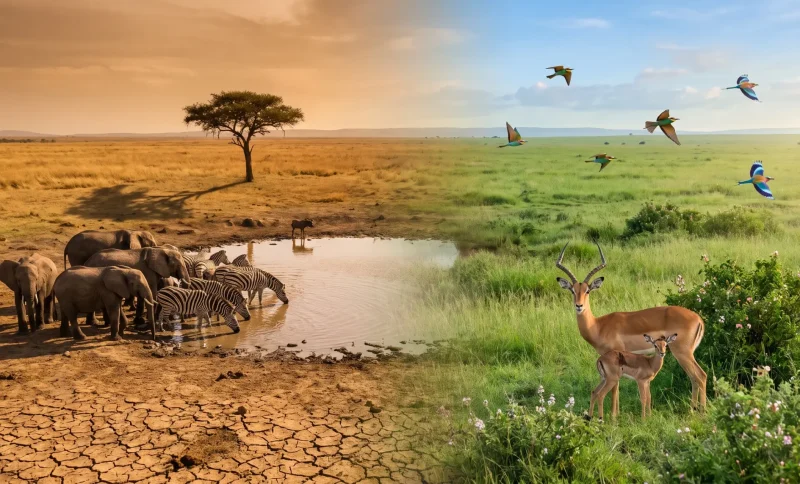
In Kenya and Tanzania, the dry season runs roughly from late June through October. Grass shrinks, water holes concentrate, and animals gather in predictable spots, making sightings easier and more frequent.
This period also overlaps with the tail end of the Great Migration, when wildebeest and zebra herds cross the Mara River between July and September, chased by crocodiles and trailed by predators.
Because this window is so reliable for game viewing, it’s also the busiest and most expensive time to travel. Lodges in the Maasai Mara and Serengeti fill up months in advance, and vehicle numbers at popular river crossings can be high. Traveling in June or October, just outside the peak crowd months, often delivers similar wildlife activity with fewer other vehicles around.
Southern Africa’s Winter Works Differently
South Africa, Botswana, Zambia, and Zimbabwe follow a similar dry season, but their winter falls between May and September, with cooler temperatures, especially at night and in early morning game drives.
In places like the Okavango Delta and Chobe National Park, the dry season pushes animals toward permanent water sources, concentrating elephants, buffalo, and predators in visible, accessible areas.
This is also when many riverbeds recede and floodplains dry out enough for vehicles to access areas that are impassable during the wet months. Visibility improves as vegetation thins, so spotting leopards in trees or lions resting in shade becomes noticeably easier than during the lush green season.
The Case for Traveling in the Green Season
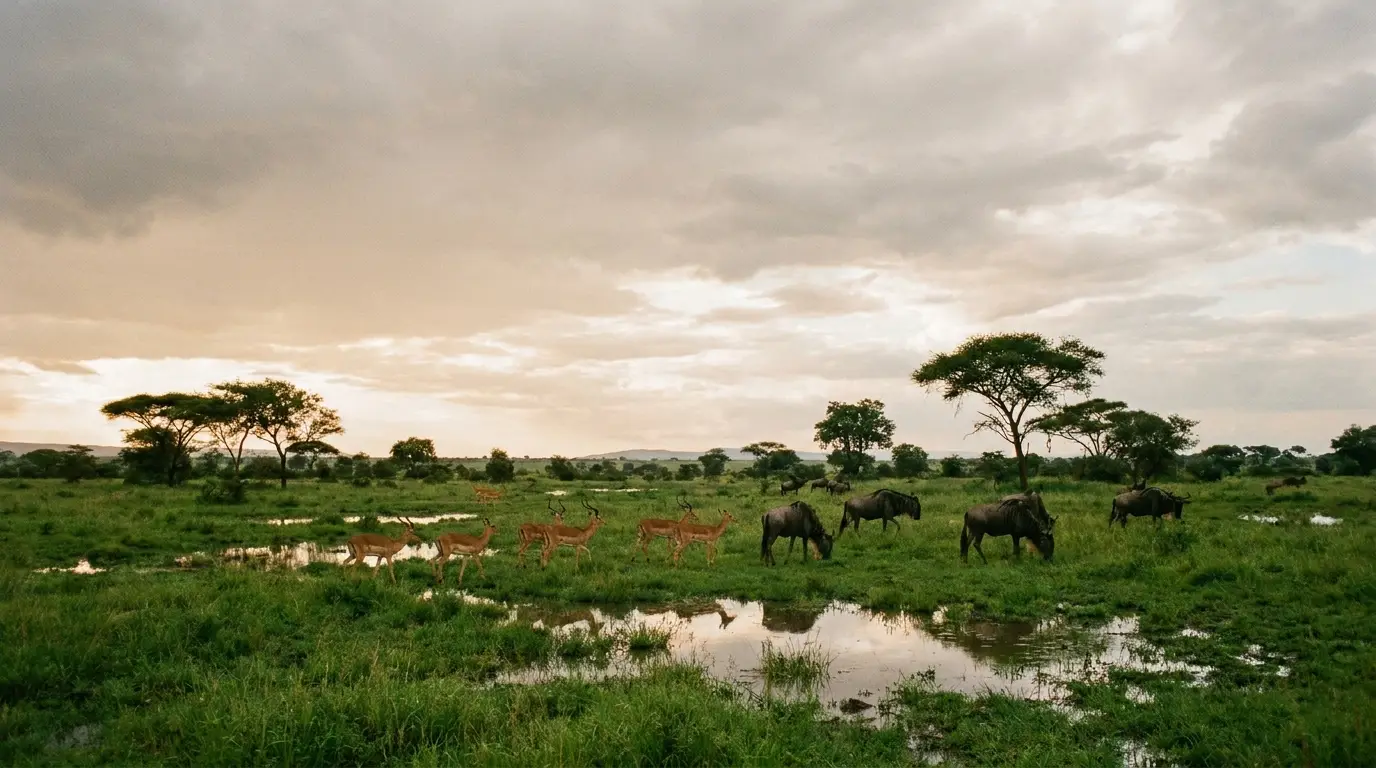
Africa’s wet season, generally November through April depending on the region, gets a reputation as the “off season,” but that label undersells what it actually offers. Rain typically falls in short afternoon bursts rather than constant downpours, and mornings are often clear and cool.
Landscapes turn vivid green, migratory birds arrive in large numbers, and many antelope species give birth, drawing predators into more active hunting behavior.
Prices drop substantially during these months, and lodges are far less crowded, which appeals to travelers who prioritize a quieter, more personal experience over guaranteed high-density sightings.
This is also a comfortable time of year for small group tours to Africa, since smaller parties can move flexibly around weather and take advantage of lower rates without sacrificing access to good guides or well-run camps.
Regional Rain Patterns Worth Knowing
Rainfall doesn’t behave uniformly even within a single country. Northern Tanzania’s short rains typically fall in November and December, while the long rains arrive between March and May, sometimes making certain roads impassable.
Namibia, by contrast, receives so little consistent rainfall that its safari experience barely changes month to month, aside from temperature swings that can be extreme, dropping below freezing on winter nights in the desert.
Uganda and Rwanda, where gorilla trekking is the main draw, see rain nearly year-round because of their equatorial, forested terrain. Trekking is possible in any month, though trails turn muddier and hikes more physically demanding during the heavier rain months of March through May and October through November.
Matching the Season to Your Priorities
If the goal is witnessing dramatic wildlife concentrations and predator action with minimal effort, the dry season in East or Southern Africa delivers the most predictable results. If budget flexibility, birdlife, and newborn animals matter more than guaranteed big cat sightings, the green season offers real advantages most travelers don’t discover until after they’ve gone.
Weather alone shouldn’t dictate the decision, though it should shape expectations. A rainy afternoon in the Serengeti in December looks completely different from a rainy week in Uganda’s forests in April, and neither should be treated as a reason to avoid travel altogether.
The real takeaway is this: pick the region first based on what you want to see, then check that specific area’s dry and wet season calendar rather than relying on generic “best time to visit Africa” advice. A well-timed trip to one country’s rainy season can outperform a poorly timed trip to another country’s dry one.