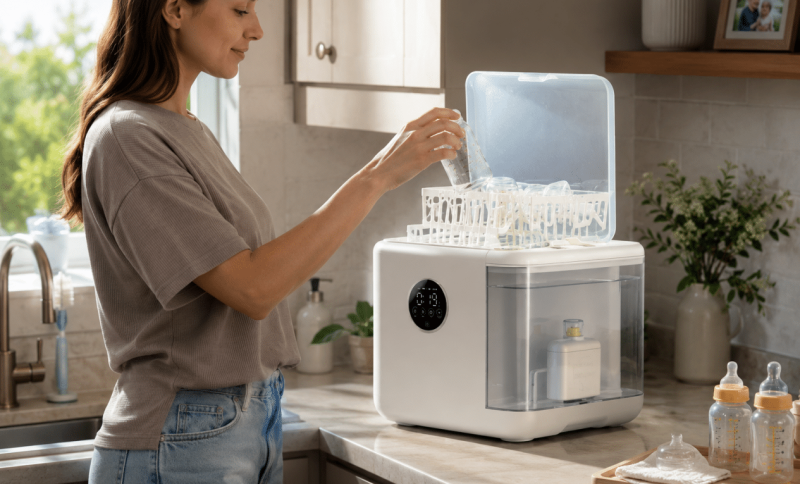
When bottles and pump parts start stacking up faster than anyone can wash them, an automatic bottle washer can feel like the obvious fix. The real question is what it handles well on tired nights and what you still need to check before the next feed. The sections that follow take up repeatable cleaning, closed drying, rack fit and loading, nipple checks, and long-term maintenance.
Table of Contents
- Automatic bottle washers handle repeatable cleaning well
- Closed drying and storage reduce counter handling
- Odd bottle parts can block spray coverage
- Nipple openings and dried residue still need checking
- Hard water and loading habits affect long-term results
- Conclusion
Automatic bottle washers handle repeatable cleaning well
You can wash baby bottles by hand. The harder part is doing it the same way every time. When you run several bottles a day, plus pump parts or pacifiers, the sink work comes back before the last batch is dry.
A washer helps with the steps that are simple on paper but easy to rush when everyone is tired. Bottle interiors, collars, and pump parts all need steady water contact. A brush can reach those spots when you have time to work at every angle. On a rushed night, the same corner is easy to skip twice.
Put the load on a fixed cycle, and the spray hits the same surfaces each time, rather than a quick midnight scrub. You may still check a corner afterward, but you are not rebuilding the wash from scratch every night. Bottle bases get less second-guessing, fewer parts sit half washed by the sink, and the next bottle is easier to grab when a feed is coming up.
The machine earns its place when volume stays high. One or two bottles a day may not feel worth the counter space. Washing after every feed, or running pump parts through the same load, is where the routine starts to add up.
Closed drying and storage reduce counter handling
Clean bottles can still spread work across the counter. Damp racks, rolling valves, and nipples handled again before storage are where the routine often slows down after the wash is done.
Keeping the load in one chamber
Most open setups split the job across the sink, a drying rack, and the cabinet. A closed washer keeps one load moving through washing, steam, drying, and sometimes short storage without those extra moves. Clean and damp pieces are less likely to mix on the counter.
Drying inside the chamber, not back on the rack
That closed path only pays off if the bottles do not leave the machine still damp. Rack drying works for a bottle or two and uses no extra power, but it puts parts back on the counter and takes longer. Heated drying inside the chamber finishes the load before you open the door, which is usually what makes a high-volume routine actually feel done.
When the routine needs to be repeatable
Once wash and dry stay in one machine, the routine is easier to repeat than a sink-and-rack system built around one person. When a relative or sitter helps with feeds, that matters even more. You can browse eufy mom&baby to compare models that handle wash, dry, and storage in one unit.
Odd bottle parts can block spray coverage
Water only cleans what the spray can reach. Once you load real parts from your own bottle setup, wide-neck bottles, vent assemblies, and pump flanges all sit differently on the rack.
When fixtures or layouts do not fit
Fixed nipple, valve, and vent holders are usually sized for common wide-neck bottles and standard pump kits. Extra-long vent tubes, wide collars, or unusual valve shapes may sit loose or have no dedicated slot. Check the manual loading diagram against what you wash every day before assuming your full bottle setup will load without extra fuss.
Where spray tends to miss
- Loose or tilted parts: the shell rinses while inner folds, slits, or openings stay dry
- Valves and vents too close together: spray hits the outside while the crease stays protected
- Crowded racks: even a mixed-use layout cannot reach what another piece is blocking
Directional spray helps, but it cannot fix a loose fit or a blocked path. Match unusual pieces to the manual diagram, pre-rinse if needed, and leave space between parts.
Nipple openings and dried residue still need checking
Nipples and small vent pieces hide dried milk in slits and holes you cannot see from the outside. After a cycle, you may still squeeze the tip or check an opening even when the surface looks clean. On parts this small, that check is routine.
Milk residue can dry inside those slits or around the tip. A quick squeeze under clean running water after the cycle may reveal film that looked fine on the surface. Dried-on milk near a collar thread, nipple base, or vent channel may need soaking, or a manual loosen before the cycle. Thicker formula, or feeds prepared under medical guidance, can leave film that spray alone does not fully clear, so a short pre-rinse before loading usually helps.
|
Mess type |
Washer usually handles it well |
Check by hand |
|
Fresh bottle film |
Yes, if loaded correctly |
Usually quick visual check |
|
Dried milk at threads |
Often, but not always |
Loosen first if crusted |
|
Nipple tip residue |
Surface yes, opening varies |
Squeeze and inspect |
|
Folded silicone valve |
Only if spray reaches it |
Reposition before cycle |
|
Thick old residue |
Less reliable |
Soak or pre-rinse first |
Before loading, check collar threads and dried edges. After drying, squeeze the nipple and look at the tip.
Hard water and loading habits affect long-term results
Any automatic bottle washer that heats water through small spray paths needs regular care. Hard water wears down results through minerals in the water, and crowded racks do it through how tightly you load the rack.
Hard water and descaling
In hard water areas, white film or scale can show up faster than you might expect. Cloudy bottles after a cycle often mean hard water minerals left film on glass or plastic, not a broken washer. If you run bottles and pump parts through the same load every day, that haze can build up on bottle walls over a few weeks.
The eufy Baby Bottle Washer S1 Pro includes a built-in water softener that stops hard water minerals, helping prevent the cloudy film and limescale buildup on bottle walls in hard-water homes. Its rack fits up to 10 bottles, or 4 bottle sets plus a full pump kit, for a full day of bottles and pump parts in one load. It also runs washing, 212°F steam sterilization, and drying in the same chamber, with storage for up to 72 hours after the cycle. When you wash after every feed, the day’s bottles and pump parts can stay enclosed instead of moving back to the counter, and you or another caregiver can take from the same load for the next feed. Over weeks of daily use in hard water, scale can still build up inside the machine and on the softener filter. Keep descaling tablets and filter swaps on the schedule in the manual, so the softener keeps working.
Loading habits and spacing
A tight rack has a similar slow effect on spray and drying air. When you fill a rack that size, spacing still counts. Bottles and pump flanges pressed together block spray and heated airflow the same way an odd-shaped valve can. Leave gaps between pieces, and recheck small valves and nipples before and after heavier loads.
If you pump and bottle feed the same day, both need counter room. Once you know how much counter space a daily bottle load takes, eufy breast pumps let you compare models that fit that layout.
Conclusion
An automatic bottle washer helps most when bottles and pump parts keep stacking up. It makes washing, drying, and storage more consistent than a tired sink routine, but odd valves, nipple openings, and dried residue still need a quick check before the next feed. Hard water and crowded loads need regular maintenance. The repeat cycles move to the machine. Loading, upkeep, and the pre-feed check stay with you.